
The following account is what I learned from relatives, some of who teach history in different universities throughout the Middle East, from what I read in such books as
Biladuna Falstine, and from my father's own personal experience. Below is the story of my father's Palestinian Diaspora that he experienced at the age of 16. It is confirmed by living references with additional information about where they now live.
STORY I
This story is based on my father's account, He was the eldest of 5 brothers and a sister. He said that one day when he was 16, he was returning home from the village school only to find a fence around the village. The fence was supposedly built by the Israeli army after the massacre at
Deir Yassin. In order to be able to pass through the fence to get to his house, my father had to be claimed by his mother from inside.
Everyone in the village was so scared that a massacre similar to the one that took place at
Deir Yassin would happen in al-Masmiyya
al-Kabira and also in neighboring villages. The Israeli army itself and some other radio stations added to everyone's fear by broadcasting news of massacres. People started fleeing the villages and went towards Gaza because it was supposedly safer since it was under Egyptian rule. The three main roads that intersected
at Masmiyya, either led towards Jerusalem,
Ramallah, or Gaza.
The safest way to leave was by the road leading to Gaza. While traveling on foot, with animals like donkeys, sheep, and goats, my father said that the Israeli army was bombing right behind the traveling villagers to make sure they would not even think of going back. My father covered his younger brothers with plastic containers
(Tisht) whenever a bomb exploded so he could protect them from the flying debris. Though the bombing was very close, there were very few casualties. Those that were killed or injured were mostly older men and women. My father could not have remembered or even observed everything that happened since there was so much fear and chaos.
The villagers at last reached a place in Gaza and later migrated to a somewhat better location. This is what happened to most of the refugees who went to Gaza. I heard very similar stories from people who were forced out of their villages close to
al-Masmiyya such as Beit Iksa. An account of this village was related to me by one of my father's high school friends that I recently met in Freemont, USA.
My father was among the lucky people who were able to finish high school in Gaza. He then went to Cairo University on a scholarship from the Egyptian government, became a civil engineer and worked in Kuwait for 35 years until 1990 when the Gulf war broke out. He then left Kuwait 8 months after the war to live in Amman, Jordan.
My father's name and address are: Yousef Abudayyeh, Adbulrahman Gorayeb Estates, Fawzi
El-Ma'aloof street (crosses Rainbow street), Jabal Amman. Phone 64615284.
STORY II
This is based on accounts related by my relative Dr. Ismail Yaghi, Professor of History in Saudi Arabia who also contributed to the Palestine Encyclopedia along with other relatives such as Dr. Hashem
Yaghi, Dean of the Department of Literature at the University of Jordan, and Dr. Abdul Rahman
Yaghi. Dr. Hashem Yaghi and Dr. Abdul Yaghi also contributed to the encyclopedia. The later two are my father's maternal uncles and are both living in Jordan. They both were old enough to remember the details prior to the 1948 phase of the
Palocaust.
Al-Masmiyya al-Kabira and al-Masmiyya
al-Saghira (Masmiyat al-Hurani) were one village founded by
people who migrated from Syria from a place called Masmiyya (also known as Zahraniyya after some Sheikh
Al-Zahrani). They settled in this region due to the abundance of water wells and fertile soil. Their homes were built from the
"ruins of Ascalon - according to the Biladuna Falasteen series of books. Some of the
families who lived in these two villages were Abudayyeh (known as A-Zahrani),
Yaghi, Muhanna, and Kurtum, and some other families that I do not know. The reason that there were two villages is that at one time there was a major quarrel and a big fight between the Abu Dayyeh and Muhanna families over water rights and who had more priority to provide this water to their animals and plants.
Some of the people I personally know from al-Masmiyya al-Kabira who are still living are: Mushaik
Yaghi, my paternal grandmother, who lives in Deir El-Balah in Gaza with her Daughter Nada Abu Dayyeh (my paternal aunt). My grandmother, although in her nineties, still remembers and tells stories about Masmiyya especially about a person called
Mishkhas. She keeps telling the Mishkhas stories to my father and mother whenever she visits Jordan. My father is the only one of her sons who actually remembers many of these stories and even at times corrects her. My younger uncles were too young to
remember Masmiyya. Having a sharp memory himself, my father always reconfirms that my grandmother has a very good memory and mental abilities in spite of her old age. My grandmother is in good physical shape. She travels across the bridge to Amman by herself and argues
and fights with the soldiers in the middle of the summer heat. No matter the weather, she insists on wearing her very thick thaub (Palestinian Robe).
Dr. Hashem Yaghi is my father's paternal uncle who is the dean/professor of literature at the University of Jordan. He is also Mushaik's brother. He lives in Jordan not too far from the university. He has two sons, Amr and
Anas, and a daughter, Laila.
Dr. Abdel Rahman Yaghi is another brother of my grandmother who was a professor of literature at the University of Jordan. He is the author of several books and also a contributor to the encyclopedia. He lives in Jordan near the university and is a neighbor to his brother
Hashem. He has three sons, Mudhar, Sahem, and Saru, and a daughter, Rama.
Yousef Abudayyeh is the same name as my father, my Aunt Nada's husband and from the same family. He holds a
PhD degree in agriculture (I think but am not too sure). He lives in Deir El-Balah in Gaza. My grandmother lives in a small house attached to their house (so I heard). They have two sons, Khaled and Mohammad, (I forgot if they have any other children since I am not in contact with them). He works as a director at a college in Gaza (probably the Islamic University - not sure).
Abdel Rahim Yaghi is my father's maternal uncle who lived until retirement in Kuwait and worked as a biology teacher although he was an agricultural Engineer. He lives in Jordan
(Dahiat Al-Rasheed). He is married to his Lebanese wife (Tharwat) and has a son,
Ayman, and two daughters, Samar and Lina.
Essam Abudayyeh is my uncle who now lives in the UAE. He is a teacher although he was an accountant in Kuwait for a while (al-Bank
al-Watani). One funny but true anecdote about my uncle Essam is that he once taught French when the real French teacher left at the last minute. My uncle taught this course even though he did not know a word of French. He's very adventurous. He and his wife Yusra have Ahmad,
Sami, and Laila.
Mohammad Abudayyeh is my uncle who lives in Jordan in Mukhayyam Al-Hussein and works as an accountant now. He used to work for Soft Paper Tissue company a while back. He is married to Fatma Abudayyeh and has three boys,
Fadi, Tha'er, Eyyas, and two daughters, Nisreen and Nada.
Salah Abudayyeh is my youngest uncle who recently moved from the UAE back to Gaza. He is believed to have started working in an accounting job in some college in Gaza.
al-Taiba
I always heard that many of our relatives from Masmiyya who went to Jordan lived
in al-Taiba camp (it does not look like a camp anymore). When I was young, my uncle Essam used to drive from the UAE to Jordan and visit them. He would take me along with him.
al-Baqa'a
Some of our relatives also migrated to al-Baqa'a camp at that time. I remember visiting some family there when young, but unfortunately forgot who they were.
Dr. Ismail Yaghi
I remember that he was a teacher of history in Kuwait then he got his PhD and left to Saudi Arabia and now teaches at some University there. I remember from
childhood that I enjoyed sitting in his presence because he always told stories that were revealed to him while he was
conducting history research. He is an excellent source of Palestinian History and he was a contributor to Palestine
Encyclopedia. He has two sons, Dr. Ziad, and Nihad, and a daughter Dr. Hala. His wife was
Um-Ziad (Fatima was her name I think).
| PalestineRemembered | About Us | Oral History | العربية | |
 Menu Menu |
Pictures | Zionist FAQs | Haavara | Maps |
| Search |
| Camps |
| Districts |
| Acre |
| Baysan |
| Beersheba |
| Bethlehem |
| Gaza |
| Haifa |
| Hebron |
| Jaffa |
| Jericho |
| Jerusalem |
| Jinin |
| Nablus |
| Nazareth |
| Ramallah |
| al-Ramla |
| Safad |
| Tiberias |
| Tulkarm |
| Donate |
| Contact |
| Profile |
| Videos |
al-Masmiyya al-Kabira - المسمية الكبيرة: The history of al-Masmiyya as I know it |
Posted by Abudayyeh on June 28, 2000
If you are the above author of the Article, you can edit your Article by clicking the button below:
Disclaimer
The above documents, article, interviews, movies, podcasts, or stories reflects solely the research and opinions of its authors. PalestineRemembered.com makes its best effort to validate its contents.
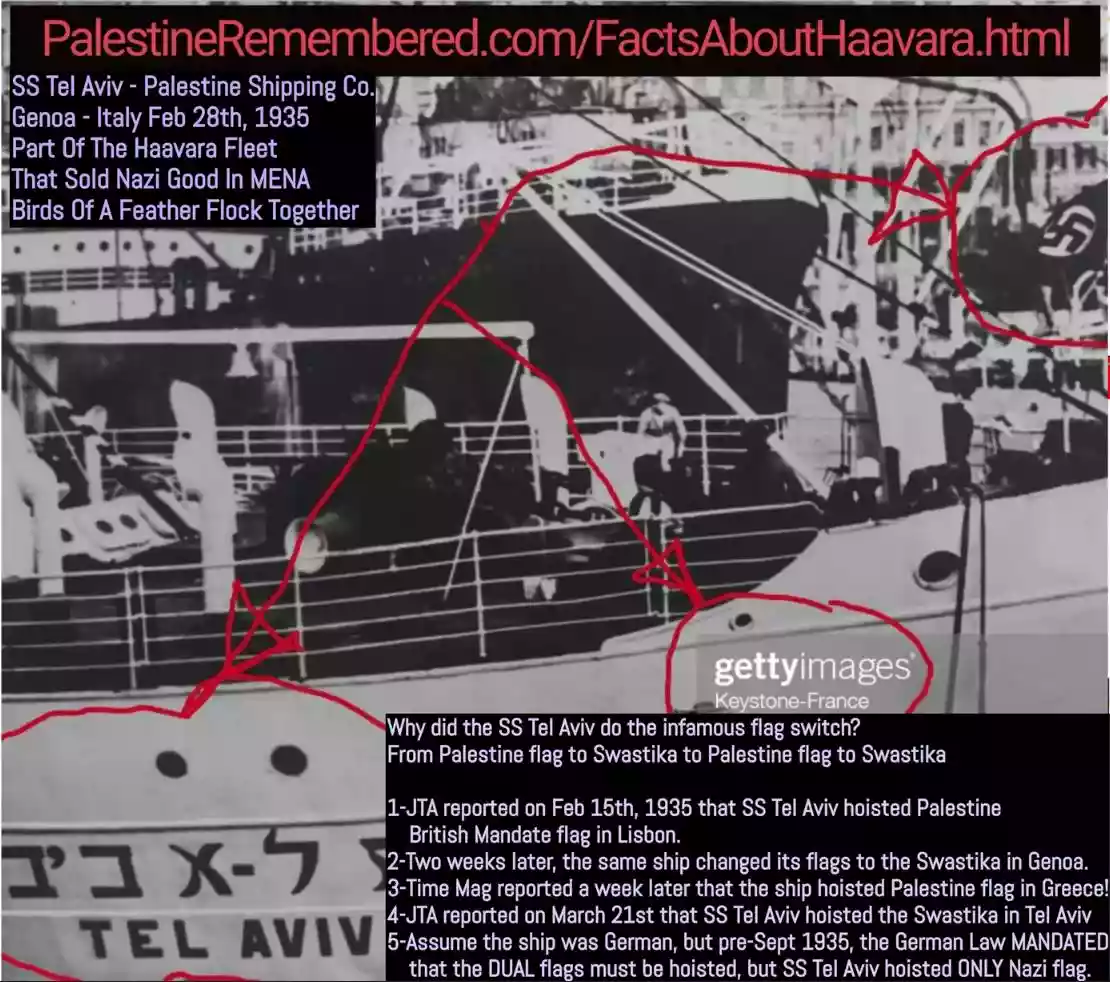 Fake Valor: Why Did Zionist Jews Hoist Nazis Flag on Their Ships in the 1930s?
What is new?
-
Facts About Oct. 7th Gaza Raid

-
Remined Us Please: Who Did Rape Whom? Was it Palestinians who raped Israelis? Or, was the other way around? You'll be the judge
-
When Prof. Edward Said was invited to debate Bibi Netanyahu in the 1980s, watch what happened!
-
Ezra Klein of the NY Times on the "Jewish Race".
-
Abusing Blood Libel!
-
How and why Israeli Jewry has become the most hated cult?
-
Did Israeli Soldiers Activate The Hannibal Direective On Oct. 7th? You Be The Judge
-
Zionist FAQ: Isn't it true that Palestinians don't want peace? Palestinians never accepted the two-state solution
- Facts about Haavara (Transfer) Agreement between Ben-Gurion & Hitler
-
Haavara FAQs: Why Did Zionist Jews Hoist Nazis' Flags on Their Ships in the 1930s?
- Haavara FAQs: When Chaim Weizmann met FDR in mid-1943, why was he silent about rescuing European Jewry?
-
Dear ChatGPT: How did Palestinians resist Napoleon's invasion of their country in 1799?
-
Dear ChatGPT: Gaza had a vibrant Jewish community in the mid-17th century. What happened to them?
-
Dear ChatGPT: Why did the Jewish Agency suppress news of the Holocaust during WWII?
-
Video Playlist: Jews share their DNA tests to end the conflict for good.
-
A Tale of Two Conflicts: Examining the Definition of Genocide
-
Prof. Abraham Polak And The Suppressed History of the Khazars and European Jewry
-
How Ronald Reagan would have framed the genocide in Gaza if he were still alive?
-
Haavara FAQs: Let us do the math: how many German Jews did The Haavara Agreement save?
-
Zionist FAQs: The Hebron Massacre of 1929, "clearly proves" that Palestinians are antisemitic, how could you deny it?
-
Zionist FAQs: Why Anti-Zionist Is Not Antisemitism?
-
Zionist FAQs: Isn't it true that the KGB created Palestinian Nationalism in the early 1960s?
- Zionist FAQs: Muslims are killing Muslims all the time; why are Israeli Jews being singled out in the media?
- Zionist FAQs: How is Israel an apartheid state when 20% of its citizens are Arabs who enjoy full rights?
-
Haavara FAQs: Why Did Dorothy Thompson Flip From A Zionist Advocate to A Silenced Dissenter?
-
Haavara FAQs: Analysis of Herzl's Uganda Scheme and how it could have saved millions of Jews.
-
Haavara FAQs: Why did Hayim Greenberg describe American Jewry as "morally bankrupt" in early 1943?
-
Haavara FAQs: What if the Evian Conference was a resounding success? What would have been the impact of saving European Jewry on Zionism?
- Haavara FAQs: What if the six million were saved, how that would have impacted the Zionist project?
-
Haavara FAQs: How did Zionist leaders react when Europe's Jews lingered in the DP camps after WWII ended?
-
Why does the American Jewish community repeat lies that David Ben-Gurion had debunked before he died?
-
Who has the power to rename the Tatar/Khazar Gene Marker to Jewish IV?
-
Zionist FAQs: Why won't Egypt, Syria, and Jordan take their people back? Jews are indigenous to Palestine, and Arabs immigrated after Jews developed the country. Arabs should leave.
-
Haavara FAQs: Did Hitler and the Nazis conflate between Judaism and Zionist? If that wasn't case, then why?
-
Haavara FAQs: Winston Churchill and antisemitism, a collection of articles written Churchill.
-
Haavara FAQs: Broken by country, how many Jews survived vs. killed during the Holocaust?
-
Haavara FAQs: Why did European Jews vote with their feet and to immigrated to the Americas, not Palestine, after WWII?
-
Watch this American Jewish Girl describing Israeli Jews' cognitive dissonance like no other in under two minutes
-
Haavara FAQs: When the Nazis went out of their way to hide the Holocaust, Israeli Jews did the exact opposite by broadcasting their genocide of Gazans. But why?
-
Haavara FAQs: How Zionist Jews went out of their to show their appreciation to Nazism and Fascism?
- Haavara FAQs: Why Zionist leaders were against bombing the death camps & the Railroads leading to them?
-
Haavara FAQs: Hitler's message to the British and American people: If Jews are such noble citizens and you care about them, how come you're not letting them in? I will gladly ship them to you at my expense, even on luxury liners!
-
A shortlist of Zionist and Israeli false flag operations in the name Jews.
-
The Most Moral Army
- The Land of Kapos (Israel): Where the brave are boycotted and Kapos walk free.
- Why did early Zionists often named their communal enterprises "colonial"?
- Zionist Relations with Nazi Germany by Faris Glubb
-
Two NY Times advertisements by Zionists in the early 1943 that exposes Zionists' treason at the height of the calamity
- Facts Not Lies about the Palestinian-Israeli Conflict.
- Site's pictures have been categorized
- Campgain Against Lice
- A Survey of Palestine, the official source about Palestine before Nakba produced by the British Mandate; over 1200 pages.
- Satellite View & Google Earth: Over 6,000 placemarks identifying all destroyed towns, W. Bank & Gaza Strip Towns, & refugee camps.
- PalestineRemembered.com and its Nakba Oral History Project were featured on al-Jazeera Satellite TV.
- Nakba Oral History Video Podcast:
 Over 700 Oral History interviews (including 3,500+ hours of recording) can be viewed online.
 - Palestine Village Statistics Project
- Gaza Jail Break
- النسخة العربية للموقع الان متوفرة
- Videos: Documenting the destroyed villages in video: Tracing all that remains since Nakba.
- Videos: Responding to Zionist Propaganda
- Interview: The ethnic cleansing of Palestine: George Galloway interviews Israeli Historian Ilan Pappe.
- For Palestinians, memory matters. It provides a blueprint for their future By George Bisharat.
- Zionist FAQ now available in Hebrew שאלות שציונים שואלים, עכשיו בעברית
- Video: The Stephen Walt and John Mearsheimer report on the influence of the Israel Lobby on U.S. Foreign Policy
- The Palestinian-Israeli conflict for beginners

Post Your Comment
*It should be NOTED that your email address won't be shared, and all communications between members will be routed via the website's mail server.