 Menu
Menu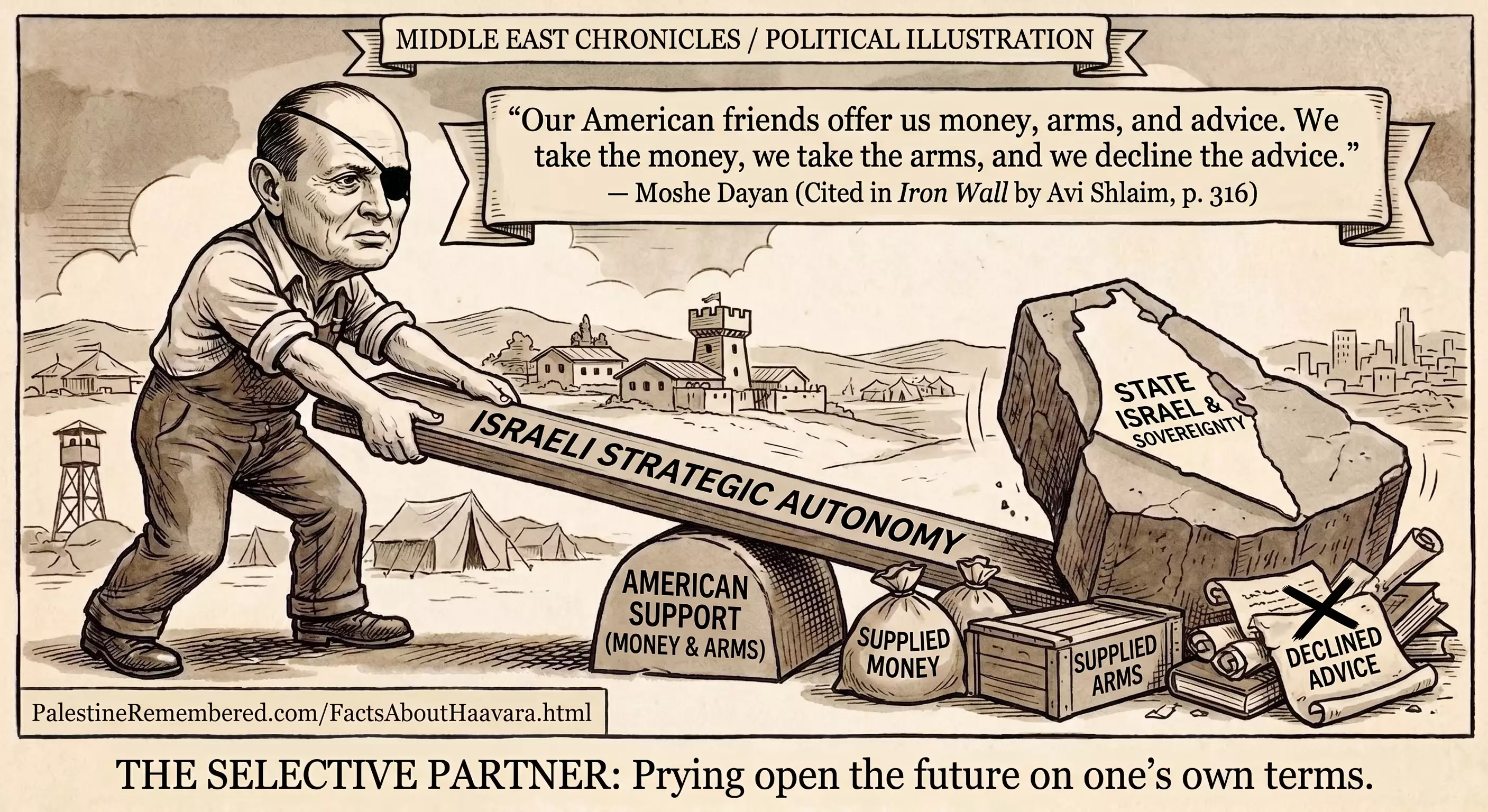 Moshe Dayan On The Selective Partner
In late April 2002, as Israeli armored columns bulldozed through the Jenin refugee camp and laid siege to Yasser Arafat’s presidential compound in Ramallah during Operation Defensive Shield, European capitals reached a rare pitch of diplomatic fury. Across Paris, London, Brussels, and Rome, European Union foreign ministers openly floated arms embargoes, trade sanctions, and the unilateral recognition of a Palestinian state.
It was during this exact diplomatic crisis that Martin van Creveld--internationally regarded as one of Israel’s preeminent military historians--sat down with Dutch journalist Ferry Biedermann for an interview in the prominent Dutch weekly magazine Elsevier (published April 27, 2002).
Speaking in his native Dutch, van Creveld issued an extraordinary, unvarnished warning across the Mediterranean:
"We possess several hundred atomic warheads and rockets and can launch them at targets in all directions, perhaps even at Rome. Most European capitals are targets for our air force... Let me quote General Moshe Dayan: 'Israel must be like a mad dog, too dangerous to bother.' I consider it all hopeless at this point. We shall have to try to prevent things from coming to that, if at all possible. Our armed forces, however, are not the thirtieth strongest in the world, but rather the second or third. We have the capability to take the world down with us. And I can assure you that that will happen before Israel goes under!"
This was not the bluster of a fringe demagogue. It was a calculated, Track-II transmission of Israeli strategic doctrine delivered directly into the European subconscious by an intellectual titan of the defense establishment.
1. The Messenger: Why Van Creveld Was the Perfect Conduit
To understand the weight of that statement, one must examine the credentials of the man who uttered it. Born in Rotterdam in 1946 before immigrating to Israel as a child, Martin van Creveld was completely at home in the linguistic and cultural nuances of the Netherlands. When he spoke to Elsevier, there was no lost-in-translation defense; every syllable was measured.
More importantly, van Creveld was military royalty. His seminal books--most notably Supplying War (1977) and The Transformation of War (1991)--were not merely shelf ornaments; they were required reading across Western military institutions, including the United States Marine Corps Command and Staff College, the US Army War College at Carlisle, and European defense academies. He was an intimate interlocutor of the Israel Defense Forces (IDF) General Staff and a frequent lecturer at foreign military headquarters.
In statecraft, when a sovereign government wishes to communicate an existential threat without triggering formal diplomatic censure or violating its own policy of nuclear ambiguity (Amimut), it does not send an ambassador. An official threat from Prime Minister Ariel Sharon to incinerate Rome would have triggered an immediate emergency NATO summit and mandated American sanctions.
Instead, states deploy trusted intellectual bellwethers. By having a world-renowned military historian casually articulate the nuclear targeting of European capitals in a respected continental magazine, the Israeli establishment achieved maximum psychological intimidation with zero state liability. If European chancelleries protested, the Israeli Foreign Ministry could simply dismiss van Creveld as an eccentric academic speaking in a personal capacity. Yet the message landed exactly where it was intended: Do not corner us, or the rules of civilization will be incinerated.
2. The "Mad Dog" Doctrine and the Theology of Leverage
Van Creveld’s deliberate quotation of General Moshe Dayan was the conceptual anchor of the interview. In the 1950s, Dayan formulated Israel’s foundational deterrence posture:
"Israel must be like a mad dog, too dangerous to bother." (Kelev Shoteh)
The essence of the "mad dog" posture is weaponizing perceived irrationality. If a small, heavily armed garrison state can convince both its enemies and its Western patrons that it is capable of unconstrained, apocalyptic violence if backed into a corner, foreign powers will calculate that containment, appease-at-all-costs diplomacy, and unconditional resupply are preferable to testing the state’s sanity.
For the Israeli political and security establishment, the world is viewed strictly through the lens of leverage. To an apparatus built entirely on militarism, every diplomatic problem is a nail to be addressed by a heavier hammer. The idea of flipping violently on Western patrons when interests diverge is not an anomaly in Zionist history; it is a recurring strategic pattern:
- The Anti-British Insurgency (1944–1947): When the British Empire sought to enforce the 1939 White Paper immigration caps, Zionist paramilitary organizations (the Irgun and Lehi, with tacit Haganah coordination) launched a brutal bombing and assassination campaign against the very empire that had authored the Balfour Declaration, executing British soldiers (the Sergeants Affair) and blowing up the British administrative headquarters at the King David Hotel.
- The Lavon Affair / Operation Susannah (1954): Israeli military intelligence orchestrated false-flag terrorist bombings against American and British cultural and diplomatic facilities in Cairo and Alexandria, intending to frame Egyptian nationalists and force Britain to maintain its military occupation of the Suez Canal.
- The 1973 Nuclear Blackmail: During the opening days of the October 1973 War, Prime Minister Golda Meir and Moshe Dayan placed Jericho ballistic missiles and nuclear-armed Phantoms on operational alert. As investigative reporter Seymour Hersh documented in The Samson Option, this was calculated Track-I coercion: it forced Richard Nixon and Henry Kissinger to launch Operation Nickel Grass, the massive American conventional military airlift that saved the Israeli frontline.
Van Creveld was simply updating this continuum for the 21st century.
3. Secular Realism Marries "Catastrophic Zionism"
What makes van Creveld’s posture so revealing is that he is emphatically not an ultra-Orthodox zealot, a messianic West Bank settler, or an unhinged political partisan. He has long presented himself as a cold, calculating Clausewitzian realist. In fact, van Creveld was one of the earliest prominent Israeli figures to argue for a complete military withdrawal from the occupied territories and the construction of a massive concrete separation barrier. His argument was brutally pragmatic: he warned that using an elite conventional military to police a captive civilian population degrades soldiers into thuggish, undisciplined paramilitaries, eroding the professional edge of the IDF.
Yet when pressed to the wall, even the most secular, sophisticated Israeli intellectual retreats directly into the core grammar of Catastrophic Zionism (Katastrophenzionismus).
Pioneered in the late 19th and early 20th centuries by Leo Pinsker (Auto-Emancipation, 1882) and Max Nordau (co-founder of the World Zionist Organization), this doctrine insists that:
- Anti-Semitism is not a societal defect that can be reformed, but an incurable, hereditary psychic pathology of the non-Jewish (Gentile) world.
- European Emancipation and universal human rights are dangerous illusions.
- The Gentile world is fundamentally, perpetually, and inevitably hostile to the Jewish people.
Because this worldview assumes that abandonment by the West is merely an inevitability waiting to happen, the moral architecture of the state permits any form of retaliation. In this ideological paradigm, if Europe sanctions Israel or withdraws its diplomatic umbrella, it is not acting out of international law or human rights considerations; it is simply revealing its immutable anti-Semitic nature. Consequently, pulling down the pillars of the global temple--the literal Samson Option--is viewed not as a crime, but as a legitimate act of cosmic vengeance.
4. The Modern Escalation Ladder: Regional Arson Before Rome
While van Creveld invoked nuclear strikes on European capitals to evoke maximum terror, real-world strategic blackmail in the 21st century follows an asymmetric escalation ladder long before ballistic missiles are readied for Paris or Rome.
If facing an existential European boycott, total divestment, or an arms cutoff, Israel’s true leverage lies just beneath the nuclear threshold:
THE ESCALATION LADDER OF EXTORTION

Level 4: The Samson Option
  └── Regional / Mediterranean nuclear deployment (The Absolute Brink)

Level 3: Strategic Energy Arson
  └── Strikes on Gulf oil hubs, shipping straits, and desalination
      plants to send oil to $400/barrel and collapse Western markets

Level 2: Digital Sabotage & Blackmail
  └── Offensive cyber strikes (Stuxnet-grade) against European infrastructure;
      weaponized leaks via Pegasus-style state-level surveillance

Level 1: Intelligence Severance & Proxy Chaos
  └── Cutting counter-terrorism intelligence sharing (Unit 8200/Mossad);
      deliberately expanding regional wars to drag the US into combat
- Strategic Energy Arson: Israel does not need to bomb Rome to shatter Europe. By launching strikes against Persian Gulf energy facilities, Kharg Island, Ras Tanura, Arabian desalination infrastructure, and the shipping lanes of Bab el-Mandeb and Hormuz, Israel can instantly crash the global energy grid. Oil spikes past $400 a barrel, global supply chains freeze, and the fragile debt architecture of Europe and Wall Street collapses overnight.
- Offensive Cyber Sabotage: Israel possesses one of the world's most aggressive offensive cyber architectures (proven by Stuxnet and the commercialization of NSO Group’s Pegasus spyware, which was discovered on the mobile phones of French President Emmanuel Macron, Spanish Prime Minister Pedro Sánchez, and top European defense ministers). A cornered garrison state can paralyze financial clearinghouses, port logistics, and power grids across Europe while maintaining total deniability.
- Intelligence Severance: Decades of bilateral integration have left Western domestic intelligence agencies (MI6, the CIA, DGSE) structurally dependent on Israeli signals intelligence (Unit 8200) for Middle Eastern threat tracking. The threat to cut off that pipeline functions as a daily bureaucratic blackmail weapon against Western interior ministries.
Van Creveld understood that Europe’s soft underbelly is its desperate addiction to economic stability. Threatening chaos is the ultimate weapon against comfortable, risk-averse Western democracies.
5. The Prophetic Mirror: Flash Eurobarometer 151 (2003)
The mainstream narrative often claims that global outrage against Israeli state conduct is a recent phenomenon fueled by social media after October 7, 2023. History completely refutes this claim.
Eighteen months after van Creveld’s interview in Elsevier, the European Commission conducted one of the most extensive public opinion audits in its history: Flash Eurobarometer 151 (polled in October 2003, published in November 2003).
Surveying over 7,500 citizens across the 15 member states of the European Union, the poll asked respondents to identify which nations presented a threat to peace in the world. Despite intense post-9/11 media campaigns framing the "Axis of Evil" as the singular danger to civilization, the results were a staggering indictment:
| Country | % of Europeans Viewing as a Threat to World Peace |
|
Israel |
59% |
|
United States |
53% |
|
Iran |
53% |
|
North Korea |
53% |
|
Iraq |
52% |
|
Afghanistan |
50% |
|
Pakistan |
48% |
In key Western European democracies, the percentage of citizens identifying Israel as a primary threat to world peace was overwhelming:
- The Netherlands: 74%
- Austria: 69%
- Germany: 65%
- Belgium: 63%
Twenty years before the destruction of Gaza, ordinary Europeans saw through the Atlanticist foreign policy consensus. They recognized what their own political leaders refused to acknowledge: that an uninspected, nuclear-armed state, driven by messianic nationalism, operating an illegal military occupation, and boasting through theorists like van Creveld that it was willing to "take the world down with us," constituted the single most combustible flashpoint on Earth.
The Bureaucratic Capitulation
The reaction to Eurobarometer 151 revealed the exact mechanism of Western paralysis that persists to this day:
- The Instant Smear: The Israeli Foreign Ministry labeled the survey "an outrage against all moral standards." The Simon Wiesenthal Center demanded that the European Union be formally stripped of its role in the Middle East peace process, claiming the poll was proof of systemic European anti-Semitism.
- The European Retraction: Terrified of the political firestorm, European Commission President Romano Prodi and External Relations Commissioner Chris Patten held emergency damage-control briefings, publicly disowned their own statistical agency’s findings, and apologized for the questionnaire.
6. The Clock Runs Out
The dynamic van Creveld laid bare in 2002 was a preview of the trap that now ensnares both Europe and the United States.
For decades, the West tolerated Israeli extortion--moral, strategic, and nuclear--because the domestic political cost of confrontation was perceived to be higher than the cost of compliance. Western leaders convinced themselves they could manage the status quo indefinitely through financial subsidies, diplomatic shields at the UN, and media sanitization.
That calculation has collapsed. Today, the horrific realities of mass civilian destruction, regional escalation, and the open contempt displayed by Israeli leadership toward international courts and Western warnings have demolished the last remnants of plausible deniability.
Europe and the United States face an unavoidable fork in the road:
- Perpetual Capitulation: Continue to bend to the threats of a rogue client state, subordinating their own domestic security, energy stability, and legal institutions to the preservation of an ethno-national fortress.
- Strategic Severance: Recognize that no state can be permitted to hold the civilized world hostage with the doctrine of the "mad dog," and enforce the universal baselines of international law, arms embargoes, and sovereign deterrence.
Martin van Creveld was brutally honest: he told the world that when the fortress is challenged, it will look for targets in all directions. The only question that remains is whether the Western world will continue to cower in the shadow of that threat, or finally summon the resolve to dismantle the leverage once and for all.


 Over 700 Oral History interviews (including 3,500+ hours of recording) can be viewed online.
Post Your Comment
*It should be NOTED that your email address won't be shared, and all communications between members will be routed via the website's mail server.