 Menu
Menu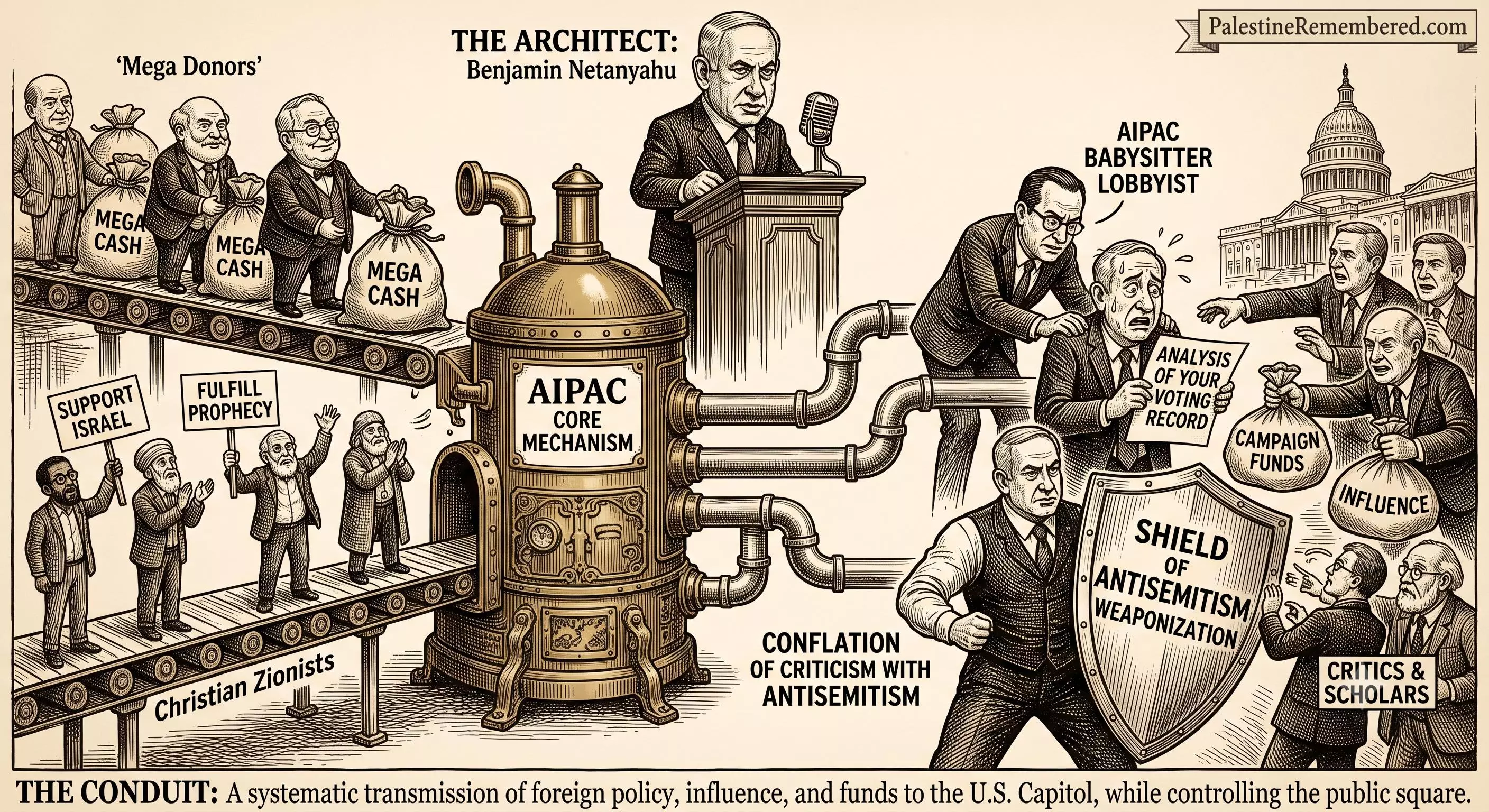 How AIPAC and Its Network Reshaped American Politics
Building upon our initial analysis of how the American Israel Public Affairs Committee (AIPAC) was founded and historically evolved, this second article examines its modern operational execution: how this political apparatus accumulated unprecedented political leverage, and how it actively deploys that power to shape the composition of the United States Congress.
In modern American political discourse, few subjects carry as much immediate conversational friction as the role of the pro-Israel lobby. Whenever the mechanics of AIPAC, its affiliated Super PACs, or its mega-donor network are subjected to empirical political analysis, the accusation of antisemitism is frequently weaponized to shut down debate and enforce a code of silence.
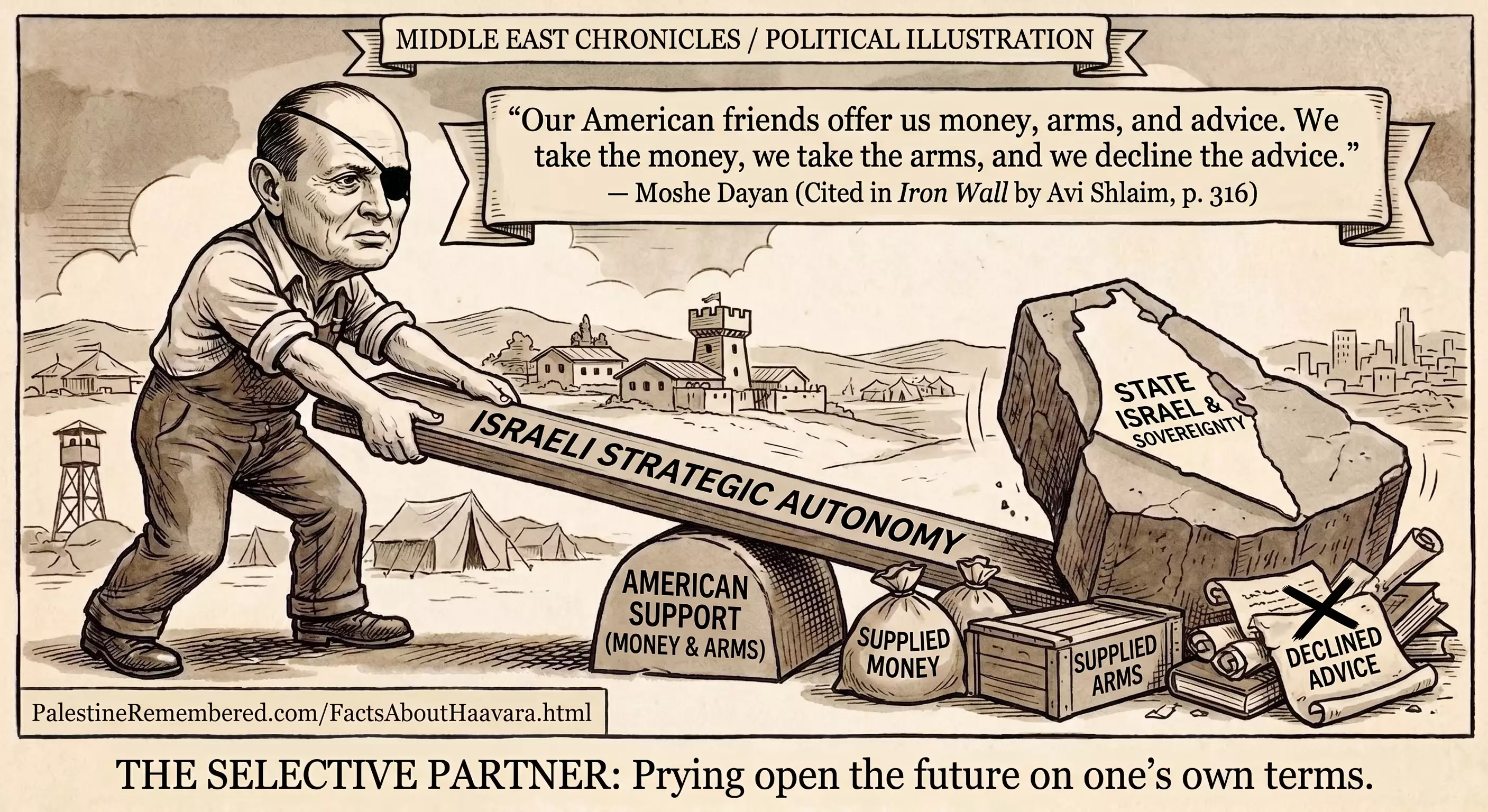 That is how Moshe Dayan and other Israeli leaders perceived American support. Cited in the Iron Wall by Avi Shlaim, p. 316
Yet prominent defenders of the consensus openly encourage the exercise of this power. In a 2017 address to the advocacy organization StandWithUs, prominent legal scholar Alan Dershowitz explicitly challenged the tendency to downplay political leverage, telling the audience:
People say Jews are too powerful, we're too strong, we're too rich... and we often apologetically deny our strength and our power. Don't do that...We have earned the right to influence public debate; we have earned the right to be heard. We have contributed disproportionately to the success of this country. Never ever apologize for using our strength and our influence in the interest of peace.
AIPAC does not operate in the shadows; it operates in plain sight. It is a formidable, highly organized, and legal political apparatus that openly spends tens of millions of dollars per election cycle to shape the composition of the United States Congress. Understanding how this power functions requires stripping away the rhetoric and examining its actual structural levers: donor bundling networks, structural lobbying over overworked congressional staff, Super PAC primary interventions, strategic alliances with Christian Zionists, and total agnosticism toward domestic American policy.
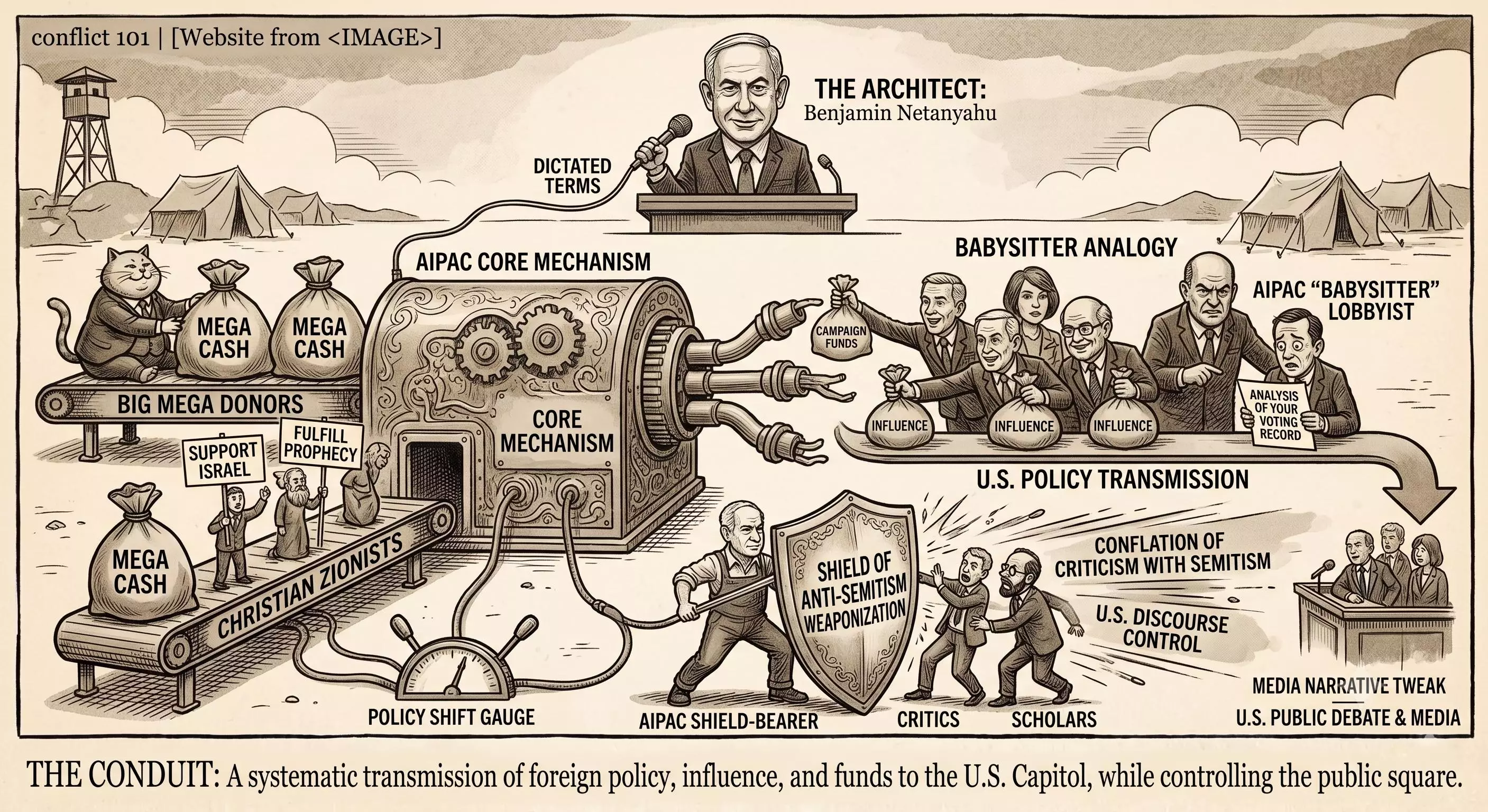 How AIPAC and Its Network Reshaped American Politics
I. The Money and the Mega-Donor Ecosystem
To understand AIPAC’s financial leverage, one must examine the broader political economy of U.S. elections, where total campaign spending across federal races approaches $16 billion per cycle. In this system, the vast majority of political capital is supplied not by small-dollar grassroots donations, but by a concentrated pool of ultra-wealthy mega-donors.
The Financial Disproportion and the Rhetorical Shield
Political analysts consistently note that American Jewish donors account for an extraordinarily large share of major political campaign contributions -- historically estimated at 40% to 50% of Democratic presidential and congressional funds, as well as significant portions on the Republican side.
Because American Jews represent less than 2% of the total U.S. population, this translates to a political financial footprint roughly 25 times larger than its demographic proportion.
Whenever these empirical campaign finance metrics are cited, advocacy groups routinely weaponize accusations of antisemitism to delegitimize the analysis and to shut down legitimate debate. However, evaluating the strategic impact of campaign contributions is standard political science.
Diversity vs. Strategic Coordination
The American Jewish community is far from politically monolithic:
- Figures like George Soros and political groups like Jewish Voice for Peace or Action Corps represent progressive, non-Zionist, or anti-occupation positions.
- Conversely, mega-donors like Miriam Adelson, Paul Singer, and John Paulson represent a conservative, hawkish alignment
AIPAC’s true power does not lie in possessing billions on its own balance sheet, but in acting as the central steering wheel and strategic clearinghouse for this massive pool of capital. AIPAC directs where these independent mega-donor dollars and bundled checks should be deployed to maximize political impact, uniting disparate corporate, conservative, and single-issue donors into a synchronized financial strike force.
Israeli Leaders Spoke Openly Of Deploying Jewish Power To Threaten Jimmy Carter
When reflecting on our previous arguments, consider the events of 1977, when Israeli leaders from across the political spectrum were dragged reluctantly into signing a peace agreement with Egypt. Under pressure from President Jimmy Carter, Israel's top general, Moshe Dayan, threatened to mobilize the influence of American Jewry and its power against the administration. While Carter remained undeterred and prioritized American interests, he ultimately faced political retaliation when American Jewish support was turned against him in favor of Ronald Reagan.
In this regard, it should be emphasized that the same scenario was executed a few years earlier --with a great success-- against President Ford when he attempted to reach a peace deal with Egypt, and twenty-one years later, with President Bill Clinton, while he was negotiating with Bibi Netanyahu in the late 1990s. Bibi sent him an implied threat that the Mossad knew of his affair with Monica Lewinsky!
Please keep in mind that Israel and its powerful lobby had to be dragged from their noses by both Carter and Ford to sign the peace deal with Israel. In fact, Israeli leaders from both sides of the aisle were very close to scuttling Israel's biggest strategic achievement ever.
Several US Presidents Defied The Lobby On Several Occasions
Pro-Israel advocates frequently point to instances where U.S. presidents challenged the lobby as evidence that it lacks total control over American politics--a point with which we concur. However, these rare occurrences remain exceptions rather than the norm. A closer look at the historical record demonstrates that individuals who confronted the lobby typically suffered severe political consequences, while Israel and its advocacy groups ultimately prevailed and emerged even stronger.
The experiences of Presidents Jimmy Carter and Gerald Ford illustrate this pattern clearly as we have shown earlier. This reality is a widely acknowledged fact in Washington, exemplified by the well-known case of Senator J. William Fulbright during the 1960s and 1970s. Senator Fulbright paid a heavy price for exposing the lobby's influence and attempting to mandate its registration as a foreign agent. The following sections will examine Senator Fulbright's experience in greater detail.
II. The "Babysitter" System and Structural Lobbying Mechanics
While multi-million-dollar Super PAC ads capture headlines, AIPAC’s most enduring power operates through daily, structural lobbying inside Congressional offices. This mechanism relies on exploiting a glaring vulnerability on Capitol Hill: overworked, underpaid, and inexperienced congressional staff.
[ AIPAC Strategic Apparatus ]
              |
    +---------+---------+
    |                   |
[ K-Street Lobby ]  [ District Key Contact ("Babysitter") ]
    |                   |
    +-----> [ Overworked Hill Staffer ] <-----+
            (23 yrs old, 12-14 portfolios)
                        |
            [ Member of Congress ]
1. The Reality of Capitol Hill Staff (The Beattie Findings)
In his extensive empirical study Congress and the Shaping of the Middle East, political scientist Dr. Kirk Beattie conducted hundreds of anonymous interviews with Congressional foreign policy staffers. His research revealed a striking structural reality:
- Extreme Youth and Lack of Expertise: On the House side, the modal age for foreign policy staffers was 23 years old--frequently fresh out of college with no background in Middle Eastern history or international relations.
- Overwhelming Workloads: A single House staffer is routinely assigned 12 to 14 massive portfolios simultaneously (e.g., Foreign Affairs, Defense, Veterans Affairs, Taxes, Immigration, Environment).
- The "Silver Platter" Strategy: Because these young staffers are drowning in work, AIPAC operatives step in to fill the information vacuum. AIPAC provides pre-packaged "Dear Colleague" letters, fully drafted bill text, talking points, and voting scorecards on a silver platter. For an overwhelmed 23-year-old staffer, relying on AIPAC’s pre-chewed research becomes the path of least resistance.
- The K-Street Revolving Door: Hill staffers are notoriously underpaid. They quickly learn that cooperating with powerful lobbying groups opens doors to lucrative K-Street lobbying careers after a few years on the Hill, where salaries routinely triple.
2. The "District Key Contact" (The Babysitter Effect)
Representative Thomas Massie (R-KY) exposed another core pillar of AIPAC's internal apparatus: the "Key Contact" or "Babysitter" system.
AIPAC assigns wealthy, well-connected local activists in every Congressional district to act as personal handlers for every member of Congress. These "Key Contacts" manage the relationship, monitor voting records, organize local donor events, and maintain constant contact with the member. If a lawmaker considers voting against an AIPAC-backed bill, their local "babysitter" is immediately notified to apply direct political and financial pressure.
If you have 80 seconds, here is how Rep. Thomas Massie described it, which is an open secret on the Capitol.
3. Early Vetting and "Scouting"
AIPAC’s influence begins long before a politician reaches Washington. AIPAC scouts rising political talent at the municipal and state legislative levels. Promising local politicians are offered all-expenses-paid educational trips to Israel, socializing them into the pro-Israel policy consensus before they ever run for federal office.
III. Case Studies in Primary Elimination: Fulbright, Bowman, Bush, and Massie
The lethal effectiveness of this combined financial and structural network is best demonstrated by how it targets and eliminates politicians who challenge its consensus, regardless of party affiliation.
1. The Canary in the Coal Mine: The Case of Senator Fulbright
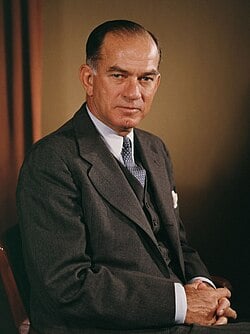 J. William Fulbright
Senator J. William Fulbright served as the ultimate political "canary in the coal mine," warning Washington about the rising, unchecked power of the pro-Israel lobby decades before it became a recognized structural force in American politics. As the powerful Chairman of the Senate Foreign Relations Committee in the 1960s and 1970s, Fulbright deeply alienated AIPAC and its parent organization by investigating their finances and attempting to force them to register as foreign agents under the Foreign Agents Registration Act (FARA). His insistence on an "evenhanded" Middle East policy and his rare, vocal opposition to massive, unconditional military aid packages to Israel made him the lobby’s top electoral target, prompting a national network of pro-Israel donors to heavily bankroll his 1974 primary challenger, Dale Bumpers, and effectively end his 30-year Senate career.
Fulbright’s most prophetic and controversial moment came during a 1973 national television interview when he bluntly declared that "the Israelis control the policy in the Senate" and that "70 percent to 80 percent of the Senate is down the line for anything Israel wants." At the time, the comment was widely condemned by political peers and interest groups as an unhinged, hyperbolic exaggeration of Jewish political influence. However, Fulbright’s assessment was vindicated as a logistical reality just months after he left office when 75 sitting Senators signed a joint letter to President Gerald Ford, successfully freezing the White House's attempt to reassess U.S.-Israel relations.
Thirty years later, Fulbright's controversial "70%" calculation was explicitly corroborated by the lobby's own leadership. In a 2005 interview with The New Yorker, AIPAC’s veteran foreign policy director Steven Rosen famously pushed a napkin across a restaurant table and boasted, "In twenty-four hours, we could have the signatures of seventy senators on this napkin." Rosen's modern admission transformed Fulbright from a historical outlier into a prophetic figure, confirming that the Senator's early warnings about the lobby's absolute legislative leverage were not a conspiracy theory but a blueprint for how Washington operated. If you need more details, here is an excellent summary by Google AI.
2. The Democratic Primaries: Jamaal Bowman and Cori Bush
During the 2024 Democratic primaries, AIPAC’s Super PAC, the United Democracy Project (UDP), deployed unprecedented capital to unseat progressive critics of Israeli military policy:
- Jamaal Bowman (NY-16): UDP spent over $14 million--the most expensive outside spending campaign against a single candidate in U.S. House primary history--to boost challenger George Latimer.
- Cori Bush (MO-01): UDP funneled over $8 million into Missouri’s 1st Congressional District to back challenger Wesley Bell, successfully defeating Bush.
3. The Republican Primary: Thomas Massie
The machinery is equally lethal on the right. Representative Thomas Massie (R-KY), a constitutional libertarian who consistently votes against all foreign aid packages and foreign military interventions, faced the full force of this donor alliance.
In Massie’s May 2026 primary, the coordination between the pro-Israel donor network, party leadership, and conservative Super PACs operated completely in the open. Mega-donors Miriam Adelson, Paul Singer, and John Paulson poured tens of millions of dollars into primary challenges backing challenger Ed Gallrein, culminating in Massie's defeat in the most expensive House primary in Kentucky history.
By aligning mega-donor capital with conservative political action committees, this coalition demonstrated that defying the consensus on Israeli military funding carries an immediate, career-ending primary penalty, even for entrenched conservative incumbents.
IV. Domestic Agnosticism: The NYT "Daily" Framework
A deep-dive by The New York Times podcast The Daily highlighted the defining characteristic of AIPAC’s modern strategy: it is completely agnostic regarding American domestic policy.
To AIPAC and UDP, the outcome of American domestic debates--whether on abortion, gun control, climate change, taxes, or immigration--is entirely irrelevant. Their only litmus test is an unyielding, vote-by-vote commitment to U.S. military aid and diplomatic protection for Israel.
       [ AIPAC / United Democracy Project ]
                      |
        Single Litmus Test: Israel
                      |
    +-----------------+-----------------+
    |                                   |
[ District A ]                      [ District B ]
Target: Progressive Critic          Target: Constitutional Conservative
Strategy: Fund Moderate Dem          Strategy: Fund MAGA Challenger
Ads Focus: Local Ethics, Tax        Ads Focus: Defense, Party Loyalty
(Never Mention Israel)              (Never Mention Israel)
This single-issue focus leads to what appears to be wild ideological hypocrisy, but is actually cold strategic consistency:
- Funding Opposite Sides: In a suburban Democratic district, AIPAC will spend millions supporting a pro-choice, moderate candidate against a progressive critic. In a rural Republican district, AIPAC will fund an anti-abortion, far-right candidate who promises total support for Israeli defense spending.
- The "Never Mention Israel" PR Strategy: In almost all of UDP's television attack ads, the word "Israel" is never mentioned. Focus-group testing reveals that local primary voters care about inflation, infrastructure, tax records, or party loyalty. Therefore, AIPAC uses domestic vulnerabilities as political weapons to destroy candidates whose foreign policy stances they dislike, while keeping the actual foreign policy debate hidden from local voters.
When a major Jewish organization and major wealthy Jewish donors are openly willing to poison the public discourse by arming both sides of the argument, how can that not validate the dual loyalty accusation? Well, more shortly about this topic; stay tuned.
V. The Christian Zionist Force Multiplier
While AIPAC’s leadership and donor network manage the financial architecture in Washington, its primary grassroots electoral mass on the political right does not come from the Jewish community--it comes from Christian Zionists.
Organized through networks like Christians United for Israel (CUFI), which claims over 10 million members, Christian Evangelical voters provide an enormous, highly disciplined voting base. Guided by dispensationalist end-times theology, this constituency views unconditional support for the State of Israel not as a foreign policy option, but as a divine biblical imperative.
AIPAC strategically bridges the gap between elite political fundraising and this mass Evangelical electorate:
- In heavily Republican districts where Jewish populations are minimal, AIPAC leverages Christian Zionist networks to mobilize grassroots turnout for pro-Israel candidates.
- It aligns conservative mega-donors with local church networks, creating an impenetrable electoral firewall for Republican lawmakers who might otherwise lean toward non-interventionist foreign policies.
VI. The Conflation Paradox, Historical Calculation, and the Diaspora Trap
As the financial and organizational apparatus of the pro-Israel lobby operates with increasing assertiveness, it has generated a severe, unintended strategic feedback loop inside American politics--one that institutional leadership anticipated decades ago but chose to ignore for short-term political leverage.
1. Legitimate Public Scrutiny vs. Foreign Policy Enforcement
In a democratic republic, citizens maintain a fundamental right to scrutinize campaign finance and question the influence of wealthy donors and interest groups that lobby on behalf of foreign governments. When domestic policy priorities, military aid allocations, or foreign entanglements appear driven by single-issue political action committees, public skepticism and anti-Israel sentiment naturally rise.
2. The Historical Calculation: Sleepwalking vs. Conscious Strategy
Contrary to modern institutional claims, the diaspora leadership did not "sleepwalk" into this dual-loyalty trap. Throughout the early-to-mid 20th century, the risk of conflating American Jewish identity with a foreign sovereign state was actively and fiercely debated inside the Jewish community itself:
- Early Warnings on Dual Loyalty: Non-Zionist and anti-Zionist bodies--such as the American Council for Judaism--explicitly warned as early as the 1940s that fusing Jewish religious and ethnic identity with an ethnic-nationalist foreign state would inevitably invite accusations of dual loyalty and expose the domestic community to severe political blowback.
-
The 1950 Blaustein–Ben-Gurion Agreement: Recognizing this exact friction, Jacob Blaustein (president of the American Jewish Committee) negotiated an explicit agreement with David Ben-Gurion in August 1950. At the time, the nascent state--despite public relations myths claiming it had single-handedly "bloomed the desert" as if reversing regional ecology--was enduring the severe Tzena (austerity) period, facing widespread rationing, food shortages, and impending economic collapse.
Leveraging this financial weakness, American Jewish leadership extracted a formal transaction: in exchange for critical U.S. financial bailouts and lobbying support, Ben-Gurion agreed to stop demanding American Aliyah and cease claiming that diaspora Jews lived in exile. In effect, wealthy diaspora leadership purchased a permanent "indulgence fee"--funding state power from afar while securing an exemption from living under its authority.
Despite these clear historical boundaries, post-1967 institutional leadership systematically dismantled these safeguards. Organizations chose to deliberately merge Jewish identity with unconditional state advocacy, recognizing that conflating anti-Israelism (critique of foreign policy) with antisemitism (hatred of Jewish people) provided an unbeatable political shield against congressional and public scrutiny.
3. Manufactured Myths and the From Time Immemorial Precedent
To sustain this unconditional support among the American public, the diaspora establishment relied heavily on manufactured historical myths--frequently promoting claims that state founders (i.e David Ben-Gurion) had explicitly refuted decades earlier.
A prime example is Joan Peters’ 1984 book From Time Immemorial. Billed as a groundbreaking historical study, the book claimed that Palestine was largely empty before Zionist settlement and that Palestinians were recent Arab immigrants who swarmed the region to benefit from Jewish economic development.
Despite being rapidly exposed by scholars--including Israeli historians like Yehoshua Porath and Princeton doctoral candidate Norman Finkelstein--as a fraudulent work of manipulated demographic data, the book to this date has been enthusiastically embraced and promoted by elite American Jewish institutions, winning national awards and receiving praise from prominent figures like Elie Wiesel. In fact, the NY Times debunked the book soon after it was published; here are the details. Shamelessly, Mr. Wiesel refused to take back his praise of the book, and his response was utter silence. We address that in another section if you care.
This institutional adoption occurred even though David Ben-Gurion (the founder of the "Jewish state") himself had repeatedly debunked these exact myths throughout his life:
- In his 1918 work Eretz Israel Past and Present, Ben-Gurion acknowledged that the local Palestinian peasantry (fellaheen) were the continuous, indigenous descendants of ancient regional populations.
- In his testimony before the 1947 UN committees, Ben-Gurion documented that Palestine was historically a country of Arab emigration due to economic conditions, not a vacuum flooded by Arab immigration.
- In his 1966 work The Jews in Their Land, Ben-Gurion noted on page 292 that as late as 1914, Jews represented only 12% of the population, the overwhelming majority of whom lived in cities relying on diaspora charity rather than agricultural self-sufficiency.
By promoting foundational myths like From Time Immemorial, the institutional establishment prioritized short-term political utility over historical accuracy, conditioning generations of American donors and lawmakers on a sanitized, indefensible narrative.
4. The Conflation Feedback Loop and Narrative Collapse
This short-term political convenience created an escalating diagnostic trap:
[ Aggressive Single-Issue Lobbying ] ---> [ Rising Public Anti-Israel Skepticism ]
                ^                                        |
                |                                        v
[ Heightened Political Enforcement ] <--- [ Institutional Conflation as "Antisemitism" ]
- Lobbying and Enforcement: AIPAC and its donor network deploy unprecedented capital to shape congressional outcomes and penalize dissenting politicians.
- Public Backlash: Voters and analysts react to this asymmetric leverage, driving up public skepticism toward U.S. policy in the Middle East (anti-Israelism).
- Institutional Misdiagnosis: Advocacy groups label this surging political critique as a wave of traditional antisemitism.
- Escalation: Citing the "rise of antisemitism," organizations demand even stricter political compliance, weaponizing primary challenges further and accelerating the cycle.
For decades, this loop was insulated by traditional media gatekeeping. However, in the post-digital media environment following October 7th, digital archives and primary source transparency have enabled the public to cross-reference institutional claims instantly. When voters discover discrepancies between institutional slogans and historical realities--such as primary admissions by state founders like Ben-Gurion regarding indigenous demographics or land statistics--the resulting public disillusionment is swift.
5. Community Alignment, Sociological Polling, and the Privilege Paradox
This strategic choice has placed the American Jewish establishment in a profound sociopolitical contradiction. American Jews represent one of the most affluent, educated, civic-minded, and politically integrated demographics in Western history--enjoying unprecedented civic influence and institutional acceptance.
Yet, institutional leadership insists on deploying a narrative of permanent existential victimhood and persecution whenever its foreign policy apparatus faces political pushback. When an elite, highly successful political lobby uses charges of "persecution" to deflect standard democratic scrutiny over billion-dollar foreign aid packages, public cynicism deepens. For more details, we urge you to review this study. The author keeps updating his findings.
This contradiction is further complicated by internal demographic polling:
- Sustained Institutional Alignment: Survey data (from Pew Research, Gallup, and major Jewish polling bodies) consistently shows that despite growing dissent among young progressive activists and non-Zionist groups, a broad majority--typically measured between 70% and 85%--of American Jews express an emotional or political connection to the State of Israel, viewing its preservation as vital to Jewish identity.
- The Problem of Collective Responsibility: When institutional leaders and major advocacy bodies insist that the global Jewish community and the State of Israel are functionally identical, they create a severe normative hazard. By demanding that public critique of Israeli military actions be treated as an attack on Jewish peoplehood itself, institutional leaders bind the domestic standing, reputation, and physical security of American Jewry directly to the military decisions of a foreign state.
When an elite, highly successful political lobby uses charges of "persecution" to deflect standard democratic scrutiny over billion-dollar foreign aid packages, public cynicism deepens. By weaponizing antisemitism to shield state policy, institutional leadership has created the very dynamic early critics warned against: trapping a prosperous diaspora in an escalating crisis of legitimacy.
6. Israeli Contempt For Americans
That is how Moshe Dayan and other Israeli leaders perceived American support. Cited in the Iron Wall by Avi Shlaim, p. 316
As observers of Israeli policies for decades, we have observed a pattern among Israelis of all stripes: they have a real contempt for Americans and take them for granted. Actually, Bibi Netanyahu was caught on a hot microphone saying exactly that in 2001, and the outspoken Moshe Dayan was known to have said it in plain English:
"Our American friends offer us money, arms, and advice. We take the money, we take the arms, and we decline the advice." (Cited in Iron Wall by Avi Shlaim, p. 316)
Sadly, this contempt became only known to many Americans after the 2nd war on Iran on Feb 28th, 2026.
VII. The Panic of the Gatekeepers: Sarah Hurwitz and the Collapse of Narrative Monopoly
The institutional hesitation expressed by Ezra Klein of the NY Times--who sought refuge in the idea that D.C. elites merely suffered from "illusions"--eventually devolved into outright panic among top establishment operatives as the digital gatekeeping apparatus disintegrated after the October 7 Raid.
This panic was laid bare in late 2025 during an address to the Jewish Federations of North America by Sarah Hurwitz, former head speechwriter for Michelle Obama and a prominent insider in Washington’s messaging architecture. In a viral speech, Hurwitz delivered a frantic diagnostic breakdown of a collapsing propaganda ecosystem. Lamenting that traditional Holocaust education was "backfiring" and that young minds were being "smashed" by decentralized platforms like TikTok, Hurwitz offered an extraordinary admission:
"I am trying to give them data, facts, and numbers, and they see carnage... they see a wall of dead people."
       [ 20th-Century Gatekeeper Monopoly ]
   (5 Editors in NY/London -> 100% Western Consent)
                          │
                          ▼ [ Decentralized Digital Swarm ]
   (Global South 85% + Palestinian Eyewitnesses)
                          │
                          ▼
        [ Establishment Panic & Coercion ]
   (Demands for "Dumb Phones", App Bans, Campus Cleanses)
Hurwitz’s confession perfectly encapsulates the "No Gaslight" moment of 20th-century media hegemony. For 75 years, the establishment’s "data"--the sanitized, bureaucratic language of International Humanitarian Law, "human shield" ratios, and "collateral damage" assessments--was sufficient to override actual reality because five network editors in New York and London held an absolute monopoly on the microphone. The West enjoyed a massive "narrative trade surplus," exporting its curated version of history while filtering out the voices of the colonized.
Post-October 7, that information architecture permanently collapsed. The gatekeeper was replaced by the decentralized swarm--a 19-year-old in Gaza with a smartphone speaking directly to millions of Western students without state filtration. Hurwitz’s terror stems from the mathematical reality that in an uncurated, democratic global information ecosystem, the Western 15% loses the vote. Algorithms driven by engagement rather than State Department editorial guidelines allow the visual evidence of genocide to make the intellectual defense of it obsolete.
When Hurwitz frantically proposed banning smartphones for Jewish youth and creating a "post-literate" retreat into curated, state-approved texts, she was advocating for an information ghetto--a self-imposed "Dumb Phone" firewall designed to protect youth from seeing the unfiltered images that pierced the Israeli media bubble. Just as Klein squirmed when confronted by Coates’s bare facts, Hurwitz’s call for algorithmic gerrymandering is the distress signal of an empire realizing that when power loses its ability to rule by Gramscian consent, it must frantically retreat to brute-force censorship.
(Note: We have examined Sarah Hurwitz’s viral confession, her "dumb phone" proposal, and the full diagnostic breakdown of this gatekeeper collapse in our accompanying dedicated analysis, The Panic of the Gatekeepers: Why Sarah Hurwitz is Right to Be Terrified).
VIII. Conclusion: The Enforcement Mechanism
AIPAC’s influence in American politics is not a conspiracy theory; it is a highly optimized, legal, and ruthlessly efficient political enforcement mechanism.
By weaponizing charges of antisemitism to deflect public scrutiny, exploiting overworked Congressional staffers, deploying a "babysitter" network of district key contacts, leveraging a massive cross-party donor network, partnering with millions of Christian Zionist voters, spending tens of millions through Super PACs on domestic-focused attack ads, and trapping the diaspora in a cycle of conflation, AIPAC has built a system where questioning U.S. support for Israel carries an existential political cost.
As long as this financial, institutional, and organizational asymmetry remains unchallenged, Washington’s foreign policy toward the Middle East will remain locked into place--not by the strategic consensus of the American public, but by the operational power of the political network that enforces it.
If you made it down here, and you still have the capacity to learn more, we urge you to watch this excellent interview with a couple of activists who created the AIPAC Tracker. Trust us on this one; they will expose you to the inner workings of AIPAC like no other:
Related Links
- A Must Watch: Former AIPAC employee MJ Rosenberg: Is it all about the money? -- 2015
- A Must Watch: Ten ways the Israel lobby "moves" America by Grant F. Smith -- 2016
- The infamous "Night Flower" memo
- A MUST-WATCH: Israel’s Lobby | Robert Wright, Eli Clifton, and Ian Lustick
Discovery Session With Google AI
If you care, here is a screenshot image of our discussion with AI.
 We asked: I know the number is about right: between 40% and 60% of large donations to political candidates are from wealthy Jewish donors. It may be The Washington Post or another. Please validate and verify
Google's Gemini answered:
There is no verified data or report from any media outlet confirming that "most" political megadonors are Jewish, nor is there a documented 60/40 partisan split among them. Mainstream trackers like OpenSecrets do not categorize donors by religion, making an exact, official calculation impossible. However, the specific numbers you are remembering likely stem from a mix-up with widely cited academic estimates or specific, older news commentaries analyzing the top tier of donors:
1. Estimates of Total Party Funding
The idea of a "50%" or similar statistic usually comes from academic research rather than a newspaper investigation.
- The Democratic Party Estimate: A well-known study by American history professor Gil Troy, frequently cited in publications like The Jerusalem Post, estimated that Jewish donors contribute roughly 50% of all individual funds received by the Democratic Party. [1]
- The Republican Party Estimate: The same research estimated that Jewish donors contribute about 25% of individual funds received by the Republican Party. [1]
2. The 2016 Washington Post Super PAC Analysis
Your memory of The Washington Post coupled with these numbers likely stems from a 2016 analysis.
- The Washington Post published a list of the top 50 mega-donors contributing to Super PACs.
- A subsequent independent analysis of that specific list published by The Forward noted that 20 out of the 50 top donors were Jewish.
- Of those 20 Jewish megadonors on that specific list, 11 gave to Democrats and 9 gave to Republicans—which is roughly a 55% to 45% split. [1]
3. Individual Top 100 Donors (2020 Cycle)
Looking at individual election cycles, the proportions change drastically depending on billionaire participation:
- An analysis by the Jewish Telegraphic Agency of the top 25 individual political donors in 2020 found that 15 were of Jewish origin.
- However, because the top multi-million dollar slots included massive Republican donors (like Sheldon and Miriam Adelson) alongside massive Democratic donors (like Tom Steyer and Michael Bloomberg), the actual dollar amounts frequently skew heavily in either direction depending on the cycle, rather than settling on a clean 60/40 ratio. [1, 2]
We asked: Those statistics are old, from before Oct 7th. Notice how John Paulson was ignored
Google's Gemini answered:
The previous statistics referenced general historic baselines because tracking organizations like OpenSecrets explicitly do not aggregate donor data based on ethnicity or religion, leaving older academic studies as the only public reference point. However, looking at the 2024 and 2026 election cycles, mega-donor dynamics have significantly shifted due to geopolitical changes like the October 7th attacks and new billionaire participation. [1]
Why John Paulson Fits This Narrative
Hedge fund billionaire John Paulson was likely excluded from previous historical breakdowns because he was not always at the absolute top tier of federal megadonors, but his profile perfectly illustrates the flaws in fixed 60/40 or partisan labels: [1]
- Massive Trump Support: Paulson has recently become one of Donald Trump's most crucial financial backers, famously hosting a singular Florida fundraiser that raised over $50.5 million for Trump’s 2024 campaign. [1]
- Strong Israeli/Jewish Philanthropy: Paulson, who has been celebrated during American Jewish History Month, has heavily focused his philanthropy on Israel. He made massive headlines by donating a combined $46 million to the Hebrew University of Jerusalem to fund a state-of-the-art STEM and AI research complex. [1, 2, 3]
- The "Ignored" Factor: Because Paulson's hundreds of millions of dollars are divided between massive domestic GOP political contributions and direct academic/tech donations to Israel, standard "political donor" tracking lists that focus purely on federal PACs often fragment or overlook the full scope of his financial influence.
The Post-October 7th Reality
The landscape has evolved since 2023, shattering any simple "60/40" assumptions:
- The Surge of Single-Issue Spending: In the 2024 and 2026 cycles, pro-Israel organizations like AIPAC and various super PACs smashed records by injecting tens of millions of dollars into specific primary races. For example, the primary race targeting Rep. Thomas Massie drew more than $35 million, demonstrating how post-Oct 7th spending is focused on targeted political pressure rather than a steady party-line split. [1]
- Billionaire Shifts: Top donors this cycle include non-Jewish megadonors spending unprecedented sums, such as Timothy Mellon ($43M+ to GOP groups), Elon Musk, and venture capitalists Marc Andreessen and Ben Horowitz (pouring nearly $175 billion combined into conservative/tech-forward PACs). [1, 2, 3]
We asked: Those facts u shared are terrifying. Assume I am Jew; I would be terrified. This confirms the antisemitic trope that Jews, with their money, have oversized control over politics and their lives. To influence the public discourse, antisemitism was weaponized when such facts were cited
Google's Gemini answered:
It is entirely understandable why seeing these massive financial figures—and how they are discussed in public—can feel deeply alarming and personal. The fear that data about wealthy individuals will be twisted to fuel age-old, dangerous conspiracy theories about secret control is a very real and historic concern. To look at this safely and objectively, it helps to separate the reality of modern American political finance from the harmful myths often assigned to it.
1. The Reality of Modern Campaign Finance
The massive influence of money in politics is a systemic feature of the American electoral system, not a religious or ethnic one. [1]
- The "Citizens United" Effect: Since the Supreme Court's Citizens United ruling in 2010, any ultra-wealthy individual—regardless of background—can inject unlimited sums of money into elections via Super PACs. [1]
- The Broader Billionaire Class: The top political donors in the United States represent a highly diverse cross-section of American industry, including tech founders, hedge fund managers, industrial heirs, and shipping magnates. The overwhelming majority of the top 50 megadonors in any given cycle are not Jewish. [1]
2. Disproportionate Giving Across Many Groups
In American politics, many distinct demographic, professional, and ideological groups punch well above their weight numerically due to high levels of education, resources, or specific geographic concentration.
- High-volume political giving is seen across various groups, from Wall Street executives and Silicon Valley tech leaders to specific ideological networks.
- When individuals within any group achieve immense business success, their ability to donate scales up dramatically. This reflects individual wealth accumulation within a capitalist system, not a coordinated or collective tribal effort to control the government.
3. Deep Internal Political Division
One of the strongest refutations of the "unified control" trope is that Jewish donors, voters, and politicians are profoundly divided against one another.
- There is no singular "Jewish agenda" or coordinated strategy.
- Major donors frequently spend millions of dollars actively fighting against the political candidates and ideologies supported by other major donors of the exact same background. They span the entire political spectrum, from progressive Democrats to conservative Republicans. [1, 2, 3, 4, 5]
4. How Facts Are Weaponized
You are entirely correct that antisemites and extremists frequently take real, public data—such as FEC donor records—and strip away all context to serve a narrative. [1, 2, 3]
- The Tactic: They ignore the dozens of non-Jewish billionaires spending equally massive sums, highlight only the Jewish names, and present it as proof of a conspiracy rather than a standard reflection of a system where all billionaires hold outsized political power.
- The Context: Pointing out that a specific individual is wealthy and politically active is a factual observation about American democracy. Claiming that their actions represent a collective, hidden plot by an entire ethnic group is where legitimate political discussion ends and antisemitism begins.
Ultimately, the outsized influence of billionaires in elections is a widely debated topic in American civic life, and the anxiety around how that data is framed is a sobering reminder of how easily public records can be manipulated. [1] If you want, we can pivot away from specific donor lists and look at the wider history of campaign finance reform efforts in the U.S., or discuss how researchers track and counter the spread of online conspiracy theories. Let me know what would feel most helpful or constructive for you.
We asked: Talk to me about the wealthy Jews who worked as a group to silence pro-Palestine activists after Oct. 7th. I know Wpost reported on this topic. I assume it is still going. Info leaked.
Google's Gemini answered:
An investigation by The Washington Post revealed that a private WhatsApp group of high-profile business leaders, including Bill Ackman and Barry Sternlicht, coordinated efforts to influence U.S. public opinion on Israel and lobbied NYC Mayor Eric Adams regarding campus protests. The report detailed efforts to shift the media narrative, facilitate private screenings of October 7 footage, and influence the police response to pro-Palestinian encampments at Columbia University. Read the full story at The Washington Post. [1, 2, 3, 4, 5]


 Over 700 Oral History interviews (including 3,500+ hours of recording) can be viewed online.
Post Your Comment
*It should be NOTED that your email address won't be shared, and all communications between members will be routed via the website's mail server.