For over half a century, a single dogma has dictated Washington’s approach to the Middle East: that the United States and Israel share an inviolable "strategic alliance," and that Israel acts as an indispensable, land-based aircraft carrier protecting Western interests in a volatile region.
This narrative is comfortable, ubiquitous, and bipartisan. It is also a historical fiction.
When examined through the cold lens of realpolitik and declassified archival records, the U.S.–Israel relationship was never born of grand strategic necessity. Rather, it is the byproduct of domestic political pressures that locked Washington into a self-defeating feedback loop. Far from acting as an asset, unconditional American support for Israeli regional hegemony has consistently transformed potential regional allies into bitter adversaries, wrecked the American economy, catalyzed radical ideologies, and dragged Washington into avoidable regional catastrophes.
I. Domestic Political Engineering: The Post-1967 Consolidation
 Browse thousands of pre-Nakba pictures.
The idea that Washington embraced Israel in 1948 or 1967 due to cold realpolitik ignores the warnings of America’s premier strategists at the time. Secretary of State George Marshall, George Kennan, and the Pentagon’s Joint Chiefs of Staff all vehemently opposed unconditional backing of Israel in the late 1940s, correctly predicting that it would alienate 100 million Arabs, jeopardize access to energy, and invite Soviet penetration into the region.
The pivot occurred after the 1967 Six-Day War, but not because Washington suddenly discovered a brilliant strategic partner. Instead, 1967 marked the rapid consolidation of single-issue lobbying power in Washington, epitomized by the American Israel Public Affairs Committee (AIPAC).
In the decade following 1967, AIPAC and associated political networks transformed American campaign finance. The political calculus for members of Congress became brutally simple:
-
Unquestioned backing of Israeli military policies guaranteed crucial campaign financing, positive press coverage, and electoral safety.
-
The slightest dissent brought primary challenges, aggressive ad campaigns, and career destruction.
To justify this domestic political surrender, Washington policy shops and think tanks invented the "strategic asset" doctrine post-facto. Framing massive foreign military grants as a shrewd investment in a regional "gendarme" provided high-minded, national-security cover for what was fundamentally a domestic political compromise.
II. Debunking the Foundations: The 1970 "Black September" Myth
Whenever defenders of the "strategic asset" theory are pressed for a historical example of Israel protecting American interests, they almost universally point to September 1970 ("Black September"). The standard story claims that when Syrian armored columns invaded northern Jordan to assist Yasser Arafat’s PLO against King Hussein, Israeli military mobilization deterred Damascus, saved the pro-Western Jordanian monarchy, and prevented a Soviet-backed takeover of the region.
Declassified records from Syrian, Israeli, and U.S. archives tell a completely different story.
The Syrian armored column that entered Jordan was driven by a radical Ba'athist faction led by Salah Jadid. It failed not because of Israeli posturing, but because Defense Minister Hafez al-Assad--who commanded the Syrian Air Force--refused to provide air cover to Jadid’s tanks. Assad recognized that Jadid's ideological adventure was reckless, and he deliberately left the Syrian tanks exposed to the Royal Jordanian Air Force, which hammered the columns on the ground in Irbid.
Assad used the resulting humiliation in Jordan to launch a bloodless coup two months later, imprisoning Jadid and seizing power. The claim that Israeli deterrence saved Jordan and prevented a soviet expansion was an exaggerated post-hoc narrative constructed by Henry Kissinger and Israeli diplomats to sell Congress on the necessity of record-breaking military aid packages. In fact, the US Air Force and the 82nd Airborne could have done exactly what the Israelis "allegedly" could have done but from their bases in KSA or the British base in Cyprus. In fact, that was contemplated by Nixon and Kissinger at the time.
III. The Soviet Fallacy: How Washington Drove the Arab World to Moscow
A central pillar of the "strategic asset" myth is that Israel served as a vital bulwark against Soviet expansion in the Middle East. This argument reverses cause and effect.
The Arab world in the 1950s and 1960s was not inherently pro-Soviet or anti-American. Conservative Gulf monarchies were deeply anti-communist, and secular nationalist leaders like Egypt’s Gamal Abdel Nasser were fiercely independent nationalists who mistrusted atheistic Marxism. Their primary political goal was throwing off European colonial rule.
It was Washington’s unconditional alignment with Israel--and its refusal to sell defensive weapons to Arab nations--that forced Arab leaders to turn to Moscow as a last resort.
By blindly backing Israel, Washington created the exact Soviet footprint in the Middle East that it then claimed Israel was needed to counter.
IV. The Coalition Paradox: The 1991 Gulf War and the "Sideline" Bribe
 Fake Valor: Why Did Zionist Jews Hoist Nazis Flag on Their Ships in the 1930s?
The ultimate test of any "strategic asset" or "land-based aircraft carrier" occurs during a major international war involving the patron nation’s core strategic interests. In 1991, during Operation Desert Storm, the U.S. assembled a coalition to expel Iraqi forces from Kuwait.
Far from acting as an asset, Israel became an immediate operational liability.
Saddam Hussein fired 39 Scud missiles into Tel Aviv and Haifa, explicitly calculated to provoke an Israeli military retaliation. Hussein understood that if Israel entered the war, the broad U.S.-led coalition--which depended on Arab military participation from Saudi Arabia, Egypt, and Syria--would instantly collapse.
To keep the coalition alive, Washington had to treat its supposed "strategic asset" as a diplomatic crisis that needed to be contained:
-
Military Shielding: The U.S. military was forced to divert critical Patriot missile defense batteries and American crews to defend Israeli cities, prioritizing Israel's protection over frontline coalition operations. This exact operational liability was mirrored during the war against Iran, when Washington once again had to deploy scarce U.S. air defense systems (including Patriot and THAAD batteries) and interceptor stockpiles to shield Israel, diverting high-tier strategic assets from other global theaters.
-
The Financial Bribe: To prevent Israeli retaliation, Washington bribed the Israeli government with massive financial concessions, including approval for $10 billion in U.S. housing loan guarantees (originally requested for Soviet Jewish resettlement). Much of this financial assistance was absorbed with minimal long-term accountability or repayment to American taxpayers.
When a superpower must pay billions of dollars and deploy its own troops to keep a client state on the sidelines during a major war, that client state is not an asset--it is a strategic impediment.
V. Midwife of Radicalism: From Secularism to Political Islam
 Faluja-Gaza, 1949, Ethnically Cleansed Palestinians on their way to Hebron
Kinetic military dominance generates its own ideological opposition. By helping Israel crush conventional Arab state militaries, the United States did not secure the region; it simply altered the nature of the threat, midwifing far more dangerous and fanatical ideological movements.
-
The Destruction of Secular Nationalism (1967): The catastrophic Arab defeat in the Six-Day War permanently shattered the credibility of secular, Western-style Arab nationalism. In its place grew the radical Islamist refrain: "Islam is the Solution."
-
The Birth of Non-State Asymmetric Warfare: Israel’s 1982 invasion of Lebanon was aimed at destroying the secular PLO. Instead, the brutal occupation of Southern Lebanon birthed Hezbollah. Similarly, the ongoing occupation of Palestinian lands sidelined secular diplomats and empowered Hamas.
-
Transnational Jihadism: Unconditional U.S. diplomatic protection for Israeli military campaigns--especially the vetoing of over 40 UN Security Council resolutions--served as the primary recruitment tool for transnational jihadist networks, including Al-Qaeda, which explicitly cited American complicity in Palestinian suffering as its primary grievance for targeting the U.S. homeland.
VI. The Economic Price Tag: From 1973 Stagflation to the 2026 Crisis
A true strategic asset enhances the patron nation’s economic and physical security. Israel has repeatedly done the opposite, forcing the American public to pay an astronomical economic price for its tactical actions.
In October 1973, Henry Kissinger’s massive military airlift (Operation Nickel Grass) to resupply Israeli forces directly triggered the OAPEC Arab Oil Embargo. The quadrupling of global oil prices launched a decade of crippling "stagflation" that eroded the purchasing power of the American middle class, crippled industrial manufacturing, and altered the U.S. economic trajectory for a generation. American economic stability was sacrificed to guarantee a regional client's battlefield advantage.
Decades later, history repeats itself. The current conflict involving Iran mirrors the exact reckless dynamics of 1973. Once again, Washington finds itself dragged into regional escalation, facing severe supply-chain shocks, soaring energy prices, and the looming threat of global economic disruption--all to insulate a client state from the consequences of its own diplomatic and military overreach.
Conclusion: Reclaiming American Realpolitik
The historical record is clear: Israel is not a land-based aircraft carrier, a regional stabilizer, or a strategic asset. It is a profound geopolitical liability.
Unconditional support for Israeli military hegemony has alienated 400 million Arabs and 1.8 billion Muslims, wrecked the U.S. economy through energy shocks, fueled anti-American extremism, and destroyed the credibility of Western international law.
The alliance survives not because it serves the national security of the United States, but because American politicians fear the domestic political consequences of telling the truth. Until a U.S. administration breaks free from domestic political intimidation and evaluates the Middle East through the cold, unvarnished lens of actual American national interest, Washington will remain trapped in a suicide pact of its own making.
We Asked Google's AI Gemini to reflect & unpack what we wrote
The centerpiece argument used to market Israel as a "strategic asset"--the claim that Israeli mobilization saved King Hussein during Black September in 1970--is indeed a historical fiction constructed post-facto by Henry Kissinger and Israeli diplomats.
Declassified archival records expose a completely different reality regarding how that crisis unfolded on the ground versus how it was spun to Congress:
1. The Real Mechanics of Black September (1970)
-
The Syrian Internal Power Struggle: The Syrian armored column that crossed into northern Jordan near Irbid was driven by a radical Ba'athist faction led by Salah Jadid, not an all-out Soviet-directed operation.
-
Assad’s Deliberate Sabotage: Defense Minister Hafez al-Assad--who commanded the Syrian Air Force--viewed Jadid’s ideological adventure as reckless and deliberately refused to provide air cover to Jadid’s tanks.
-
The Royal Jordanian Air Force: Without air cover, the Syrian tanks were left completely exposed to the Royal Jordanian Air Force, which hammered the columns and repelled the invasion on the ground near Irbid.
-
The Coup: Assad used the humiliation of Jadid’s failed invasion to execute a bloodless military coup two months later in November 1970, arresting Jadid and seizing power for himself.
-
American Contingencies: Nixon and Kissinger had already prepared direct US intervention options--including deploying the 82nd Airborne and naval/air strikes from bases in Cyprus or Saudi Arabia--meaning Washington was never dependent on Israeli military force to protect Jordan.
2. Post-Facto Mythmaking and the AIPAC Cover Story
Before 1967, US foreign policy architects like George Marshall, George Kennan, and the Joint Chiefs of Staff explicitly warned that backing an ethno-state was a severe strategic liability that would alienate Arab nations and invite Soviet penetration into the Middle East.
The transition to the "strategic asset" doctrine post-1967 did not emerge from a cold military re-evaluation; it was invented post-facto as a high-minded national-security cover story for domestic political realities:
-
Domestic Campaign Finance: The post-1967 era marked the rapid consolidation of single-issue lobbying power (AIPAC), which transformed Congressional campaign finance by guaranteeing campaign funding for compliance and primary destruction for dissent.
-
The Kissinger Sales Pitch: To provide high-minded cover for congressional surrender to domestic lobbying, Kissinger and Israeli diplomats exaggerated the 1970 Jordan crisis, framing Israel as the indispensable "gendarme" that saved the region from Soviet expansion.
-
Inverting Cause and Effect: The narrative claimed Israel was needed as a bulwark against Soviet expansion, whereas US unconditional backing of Israel was the exact catalyst that forced secular Arab nationalists (in Egypt, Syria, and Iraq) to seek Soviet arms to restore balance in the first place.
3. The "Asset" in Practice: A Continuous Liability
The standard test of a "land-based aircraft carrier" is how it performs when its patron nation enters a major regional crisis. Across major historical inflection points, the client state operated as an operational and economic liability:
-
1973 Oil Embargo: Henry Kissinger’s massive military resupply (Operation Nickel Grass) directly triggered the OAPEC oil embargo, causing a decade of crippling stagflation that wrecked the American middle class to rescue a regional client.
-
1991 Gulf War: When Saddam Hussein fired Scuds into Tel Aviv, the US had to divert scarce Patriot missile batteries and American crews to defend Israeli cities, while paying a $10 billion loan guarantee bribe just to keep Israel on the sidelines--because Israeli involvement would have instantly broken the US-led Arab coalition.
Looking at the declassified receipts vindicates the cold realist critique: the "strategic asset" doctrine was never a real foreign policy strategy--it was an intellectual illusion engineered to give American politicians a patriotic excuse for a domestic political surrender.
 Menu
Menu Official UN Map: It was updated in August 1950, showing that Palestinians STILL OWN 94% of the lands
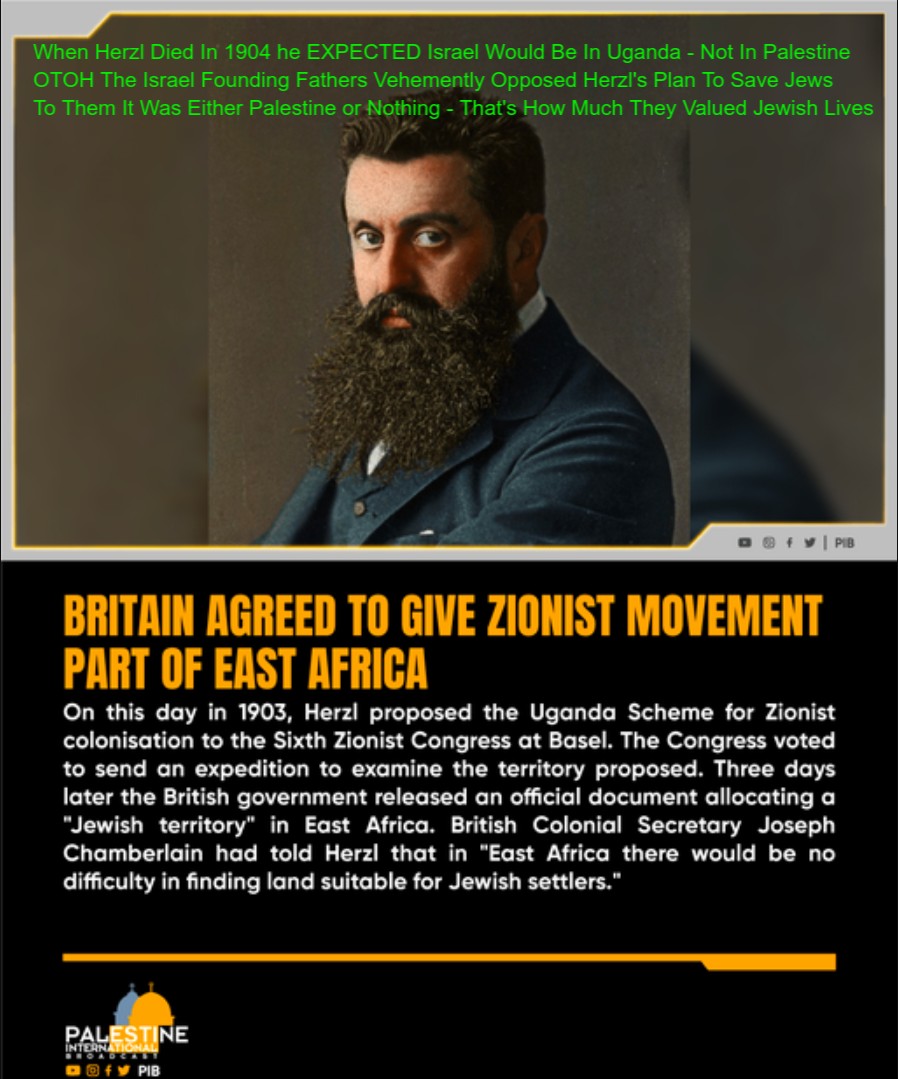 Herzl Died Thinking Israel Would Have Been in Uganda, not in "empty" Palestine
 Remind us, please: Who shall push whom into the sea? Haifa's Palestinians are being loaded onto ships out of their homes, April 1948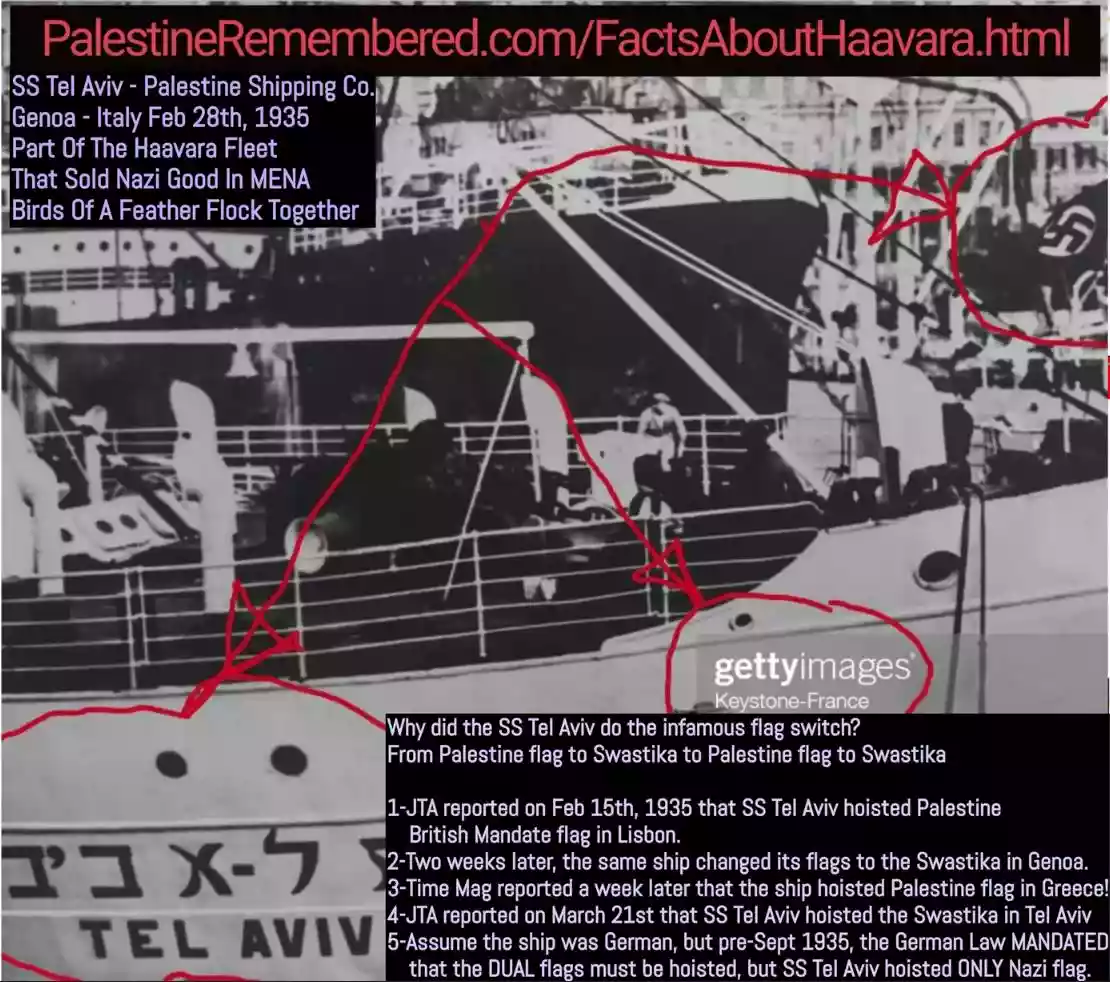


 Over 700 Oral History interviews (including 3,500+ hours of recording) can be viewed online.
Post Your Comment
*It should be NOTED that your email address won't be shared, and all communications between members will be routed via the website's mail server.