In the discourse surrounding the Palestinian Nakba, the word "replacement" is often treated as a controversial political theory. However, for those who know the history of villages like al-Tira in Haifa, replacement is not a theory; it is a documented, physical event recorded in the very stones of our schools.
To understand the "sickness" of the current geopolitical narrative--where victims are expected to provide moral absolution to their dispossessors--one only needs to look at two photographs of the same building.
The Class of 1947: A Piece of Heaven
 Shukri al-Jamal's Palace in Talibiya neighborhood in Jerusalem two days after its completion and just before Zionist Jews looted it from him and his family
The first photograph captures the 7th-grade boys' school in al-Tira during the 1946-1947 academic year. These were children with names, futures, and a teacher, Mr. Yousef Burhan al-Dajani (al-Dawoudi), who was so proud of them that he hosted a farewell party at his home in Haifa.
Look at their faces: Mahmoud Muhammad Abu Issa, Salman al-Amaysi, Omar Taha Amreen, Moussa Muhammad al-Arm, Ali Muhammad Darbas, and Nimer Abdullah al-Arm. They were the majority. They were the indigenous fabric of a "piece of heaven" that was about to be torn apart. Within a year, these boys would be "unchilded," transformed from students into refugees, their lives fractured by a European-engineered solution to a European crime.
1949: The Architecture of Theft
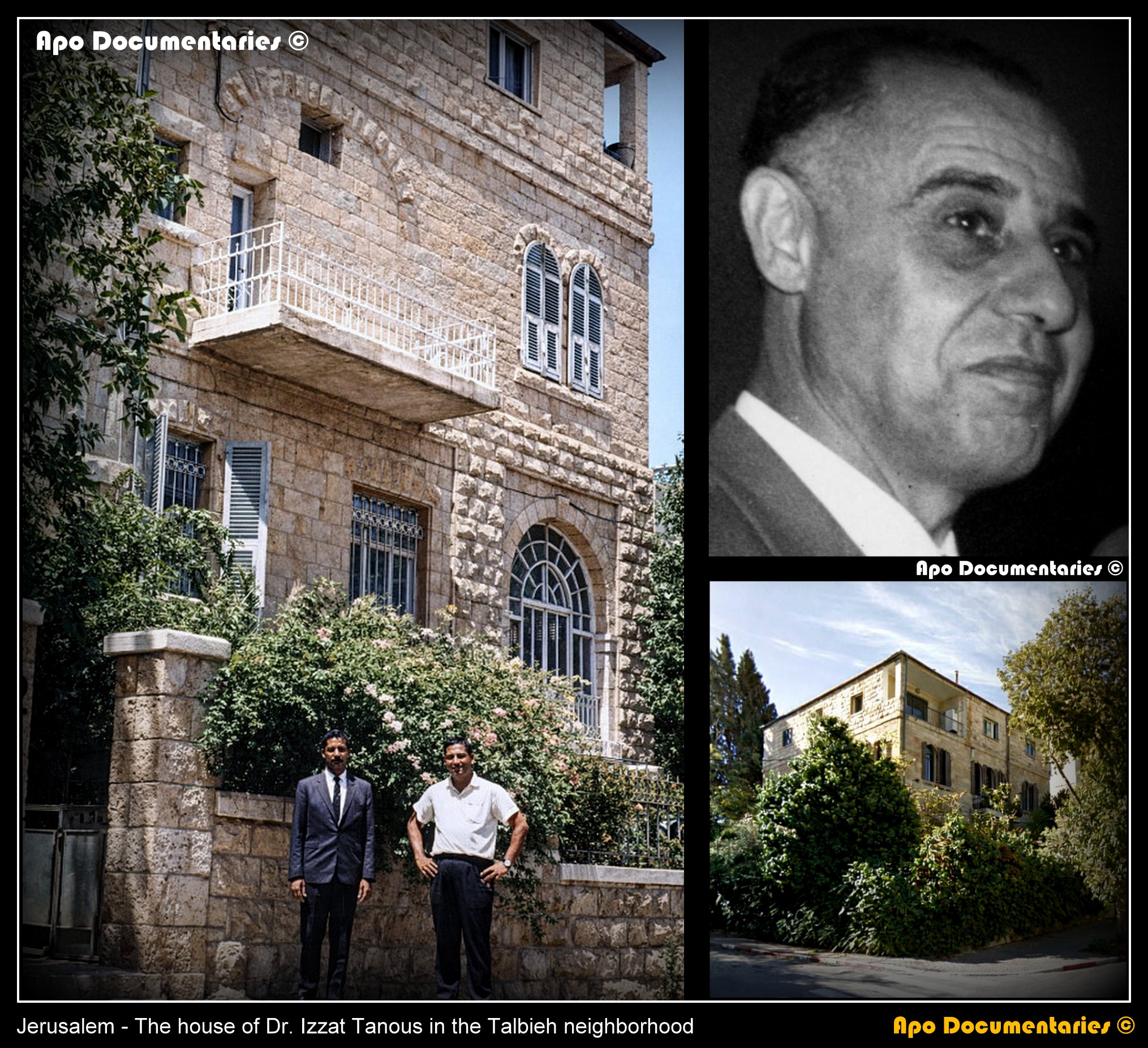 Izzat Tannous next to his looted house in Talbiyah neighborhood - Jerusalem. Israeli Jews looted it soon after Nakba
The second photograph, taken in early 1949, shows the exact same building. The arches are the same; the stones are the same. But the children are gone. They have been replaced by a new population that moved into the literal footprints of the boys who preceded them.
This is the "smoking gun" of the Nakba. It illustrates that the creation of the State of Israel was not a "land without a people for a people without a land." It was a clinical, demographic seizure of a functioning society. The new occupants sat in the same desks where Mahmoud and Salman had practiced their lessons just months prior.
The physical replacement of students in 1949 was only the first step. Over the decades, this act of dispossession transitioned into a systemic process of topographical and cultural erasure--a deliberate effort to sanitize the architectural landscape and scrub it of its indigenous Palestinian memory. Today, this erasure manifests in two distinct ways: physical manipulation and digital concealment.
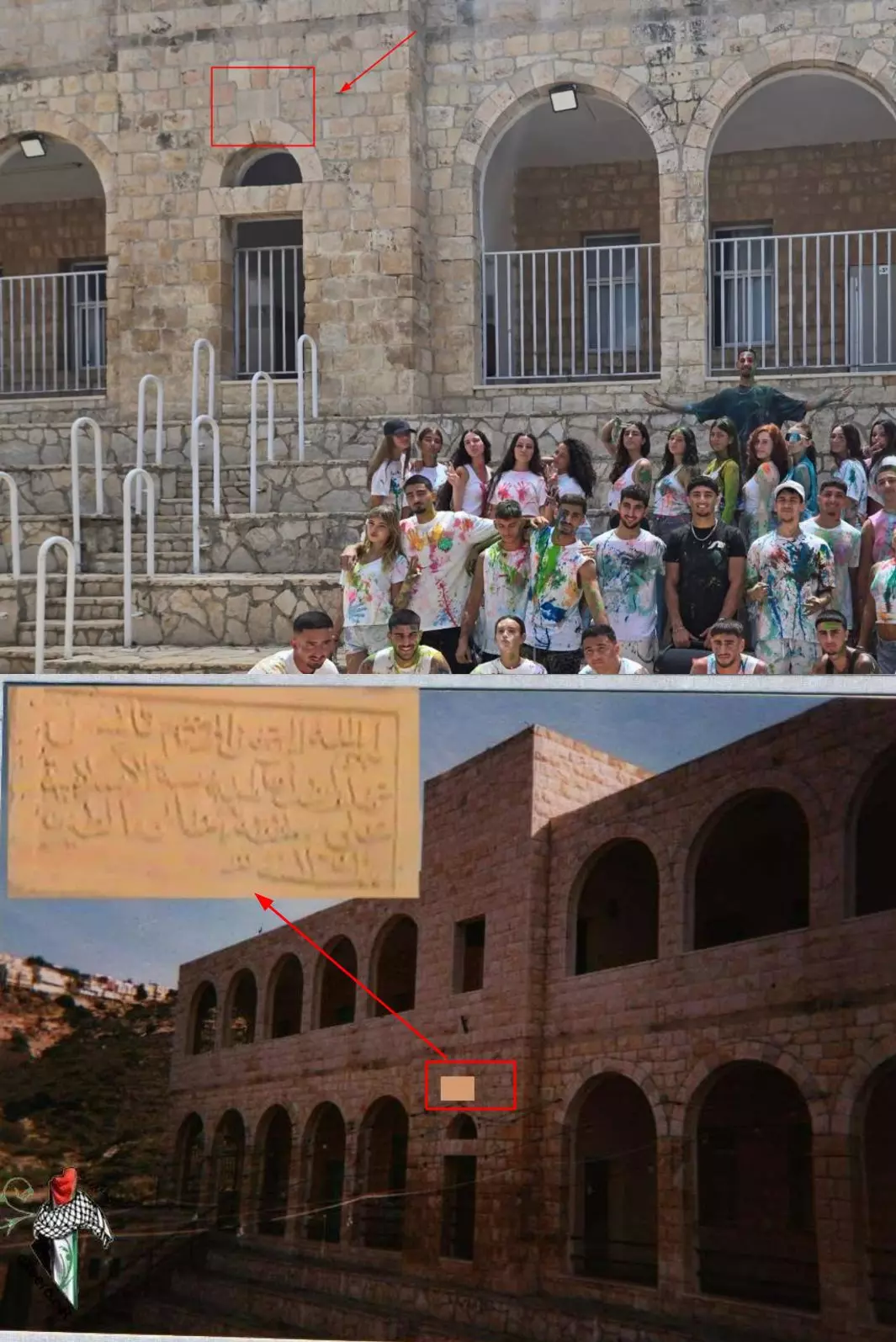 Traces of Erasure: The Mutilated Stone of al-Tira School
The most visceral evidence of this systemic silencing is found carved into the very masonry of the building. Embedded above one of the structure’s prominent archways sits its original historical foundation stone.
Historically, this limestone plaque proudly bore a beautifully carved Arabic inscription that read:
"المدرسة التي أقيمت بفضل الإسهام"
"من أبناء الطيرة الإسلامية"
"على نفقة عثمان الصباغ"
"١٣٦١ هـ" (أو ما يقارب عام 1942م للتوسعة الكبيرة)
"This school was established through the contributions of the sons of Islamic al-Tira, at the personal expense of Uthman al-Sabagh, 1361 AH (1942)."
This inscription provided irrefutable material proof that the grand arched expansion of the campus was not an inherited relic or a British gift, but a grassroots civic project funded by the wealth and vision of al-Tira's own community leaders—specifically the prominent philanthropist Uthman al-Sabagh--to ensure their children could pursue higher elementary education locally.
Instead of removing the stone and risking structural damage to the facade, authorities chose a more insidious method: they meticulously chiseled and scraped away the Arabic lettering. Today, the foundation stone remains in place but stands as a smooth, hollowed-out rectangular void. It is a physical scar designed to prevent modern students and passersby from reading the true pedigree of the building, turning an eloquent historical ledger into a mute block of stone.
What was achieved with a chisel in the 20th century is maintained with algorithms in the 21st. If a researcher or a descendant of al-Tira searches for this historical geographic space on platforms like Google Maps, they will find a total vacuum of historical context.
The plot of land located at 14 Ezra Laniado St. is strictly indexed under contemporary Israeli labels: Shifman Municipal High School (בית ספר שיפמן הדף הרשמי), Monheim Park, and the luxury Kedem Hotel. The digital landscape completely bypasses the pre-1948 realities of the site. By omitting any mention of the historic 1930 al-Tira Boys' School from the map, digital mapping tools effectively act as an extension of the original displacement, obscuring the village's continuous roots from the global public eye and formatting the space as though it began entirely anew in 1948. Please feel free to inspect Google's Street View of the exact location of the school; although the images were taken in 2011, they are still revealing.
Following the capture and ethnic cleansing of al-Tira in July 1948, the newly established municipality of Tirat Carmel immediately repurposed the empty village infrastructure to accommodate waves of Jewish immigrants. The elementary boys' school was structurally swallowed by modern expansions, eventually becoming the architectural heart of the current Shifman High School campus.
The heavy perimeter security gating and strict educational checkpoints that surround 14 Ezra Laniado St. today serve a dual purpose. Superficially, they protect a modern high school; historically, they fence off a stolen heritage. The grand stone arches built by Uthman al-Sabagh and once filled with the laughter of Mahmoud, Salman, and Omar are now sealed behind schoolyard fences—their original identity physically scraped raw, yet stubbornly refusing to disappear.
The Utility of the Lie: From al-Tira to The Economist
Shukri al-Jamal's Palace in Talibiya neighborhood in Jerusalem two days after its completion and just before Zionist Jews looted it from him and his family
The reason this history remains an open wound is that the tactics of 1948 are being used to justify the genocide in Gaza today. Atrocity propaganda relies on the "utility of the lie." A horrific claim is launched to manufacture immediate consent for violence, and it is only "retracted" years later when the physical destruction is irreversible.
We see this in the case of Shashank Joshi, the Defence Editor at The Economist. On October 22, 2023 --weeks after the "beheaded babies" narrative had already begun to crumble-- Joshi amplified the disinformation to his massive audience. He waited until March 2026 to delete the tweet, hiding behind the "fog of war."
As veterans of the wars and uprisings know, the "fog of war" is real, but it is an alibi for days, not years. In a real conflict, state actors use journalists as "fliers or kites" to plant lies. A journalist with integrity changes on a dime the moment the evidence comes through. Waiting 30 months to delete a lie is not a mistake; it is a reputation-killer. It proves the lie was maintained because it was useful.
The "Smell Test" and Informed Complicity
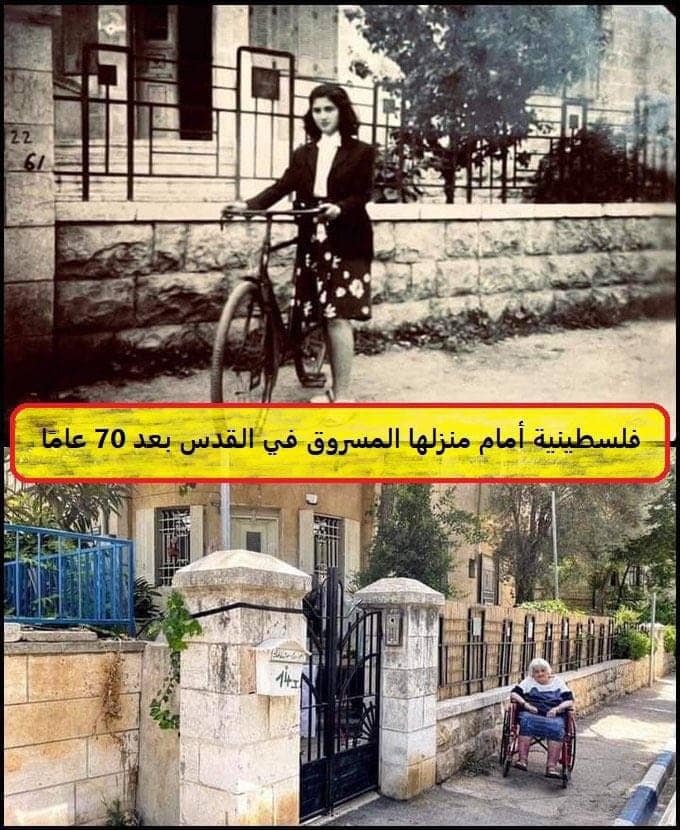 Abla Mohamad Daoud Dajani outside her family's looted house in Baq'ah neighborhood - Jerusalem. Click the image for more such pictures that document Palestinians' dispossession.
Today, the supporters of the "Jewish state" that took the school in al-Tira claim a "right to exist" while denying the Nakba. But even those who admit the Nakba often "brush it aside," a move that is double the crime. They acknowledge the theft but refuse to return the property.
This is what we call "informed complicity." Much like the German populace was held responsible for the crimes of the Nazis despite their claims of ignorance, modern supporters of the state --including the 80-90% of American Jews who support Israel's "right" to exist despite acknowledging the genocide in Gaza-- bear a heavy moral burden. They possess the truth, yet they choose the structure of oppression.
Conclusion: The Refusal to Scream in Silence
 Palestinian women harvesting cotton in the village of Kafr Saba in 1937
When Palestinians are labeled "antisemitic" for refusing to validate their own replacement, the very fight against bigotry is debased. As the editor of this website wrote to Senator Chuck Schumer: "It is ridiculous that you expect me to approve of those who dispossessed and threw me out of my ancestral lands."
The "hate" that the West claims to see in Palestinians is actually a scream for justice. It is the refusal to let the memory of the Class of 1947 be erased by the occupants of 1949. We will not offer moral absolution to a system built on inherited classrooms and weaponized lies. We will keep our "smell test" functioning 24/7, and we will never forget the names of the boys from al-Tira.
 Menu
Menu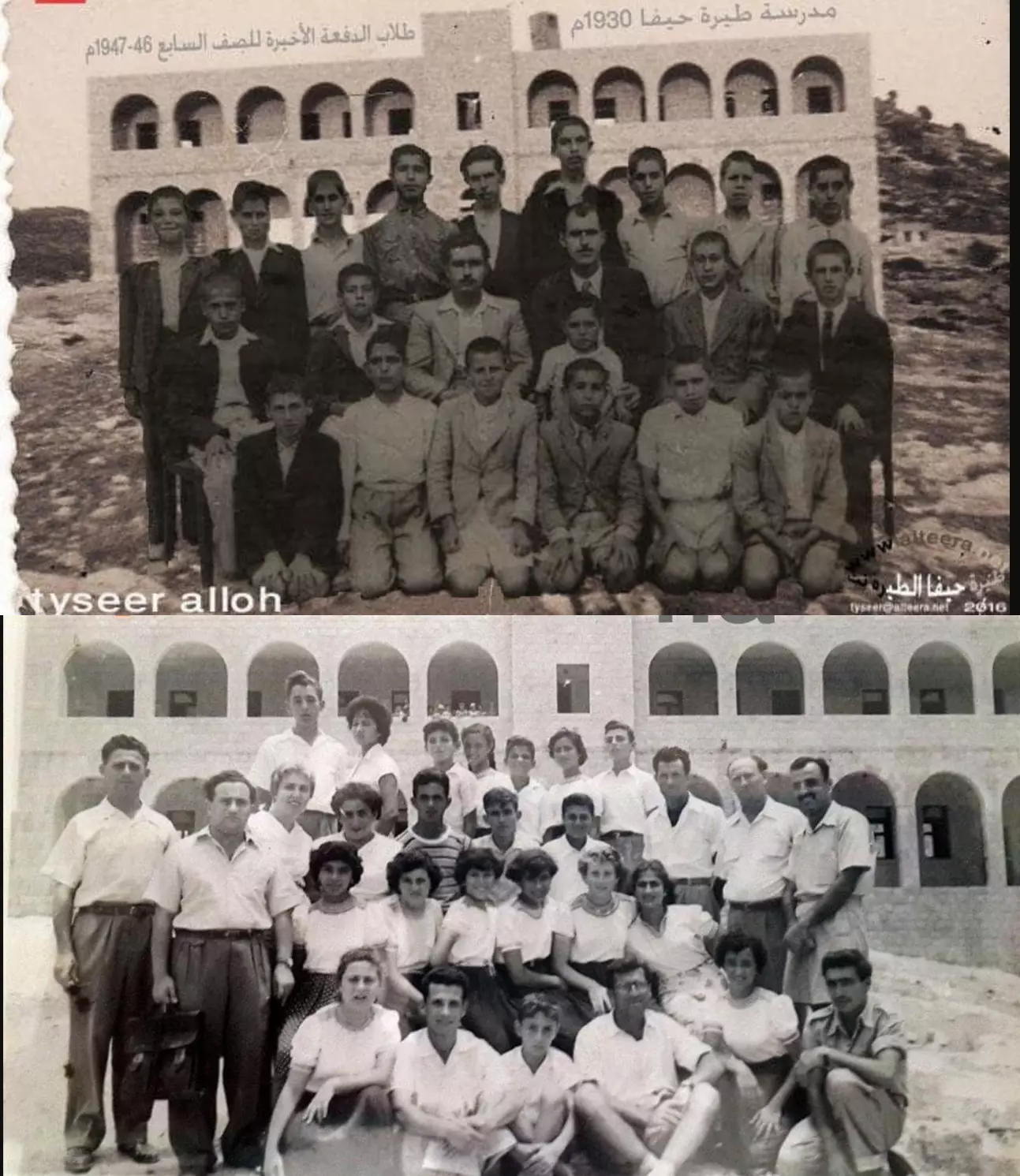 Palestinian Replacement In A Single Picture: al-Tira's school before and after Nakba. The same place but different people


 Over 700 Oral History interviews (including 3,500+ hours of recording) can be viewed online.
Post Your Comment
*It should be NOTED that your email address won't be shared, and all communications between members will be routed via the website's mail server.