 Menu
MenuWhen a political structure loses the ability to persuade, it does not gracefully retreat. It panics.
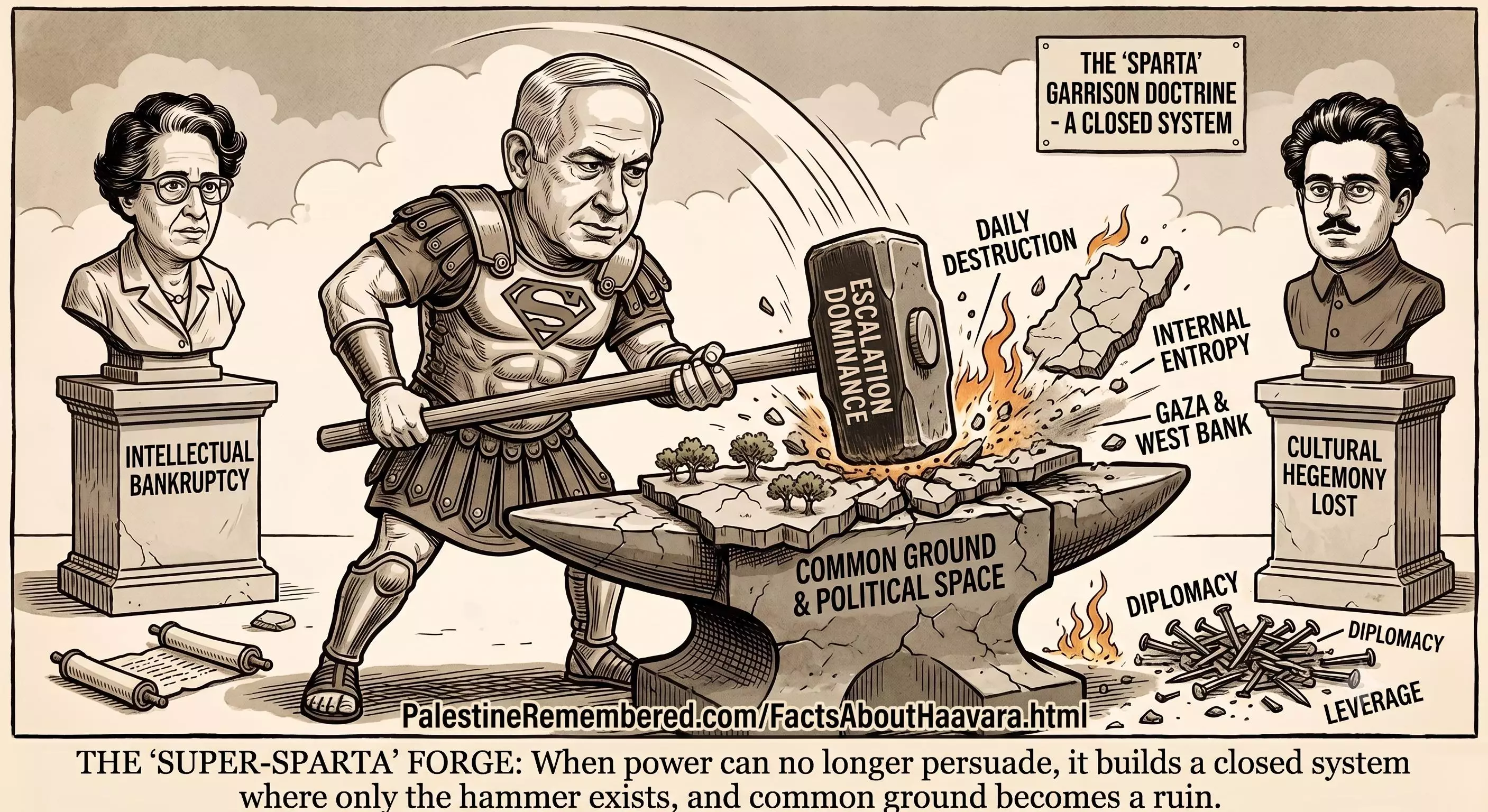 THE "SUPER SPARTA" FORGE: When the power can no longer persuade, it builds a close system where only the hammer exists.
For decades, the maintenance of state authority relied on what Antonio Gramsci termed Cultural Hegemony--the quiet, pervasive machinery of consent. Through media, educational frameworks, and shared ideological narratives, ruling institutions made their supremacy appear not merely lawful, but natural, moral, and inevitable. But when technological decentralization, independent digital archives, and real-time visual truth shatter that monopoly, consent evaporates.
Stripped of soft power, an entrenched system reaches for the only instrument left in its cabinet: the hammer.
From Ariel Sharon--who proudly wore the moniker "The Bulldozer" as a badge of strategic honor--to Benjamin Netanyahu, the Israeli security establishment has long operated on the doctrine of crude physical momentum. When all you possess is a hammer or a bulldozer, every human being, every legal precedent, every diplomatic bridge, every critical article, and every historical fact transforms into a nail to be driven down.
It is precisely here that the true character of a regime reveals itself: any system that reduces every complex human, political, and moral problem to a nail exhibits the core structural symptom of Harold Lasswell's Garrison State--an extreme, siege-authoritarianism (some might call it fascist)--irrespective of how many democratic elections it holds or how fervently it claims to be a constitutional republic.
I. The "Super-Sparta" Confession and the Capital Friction
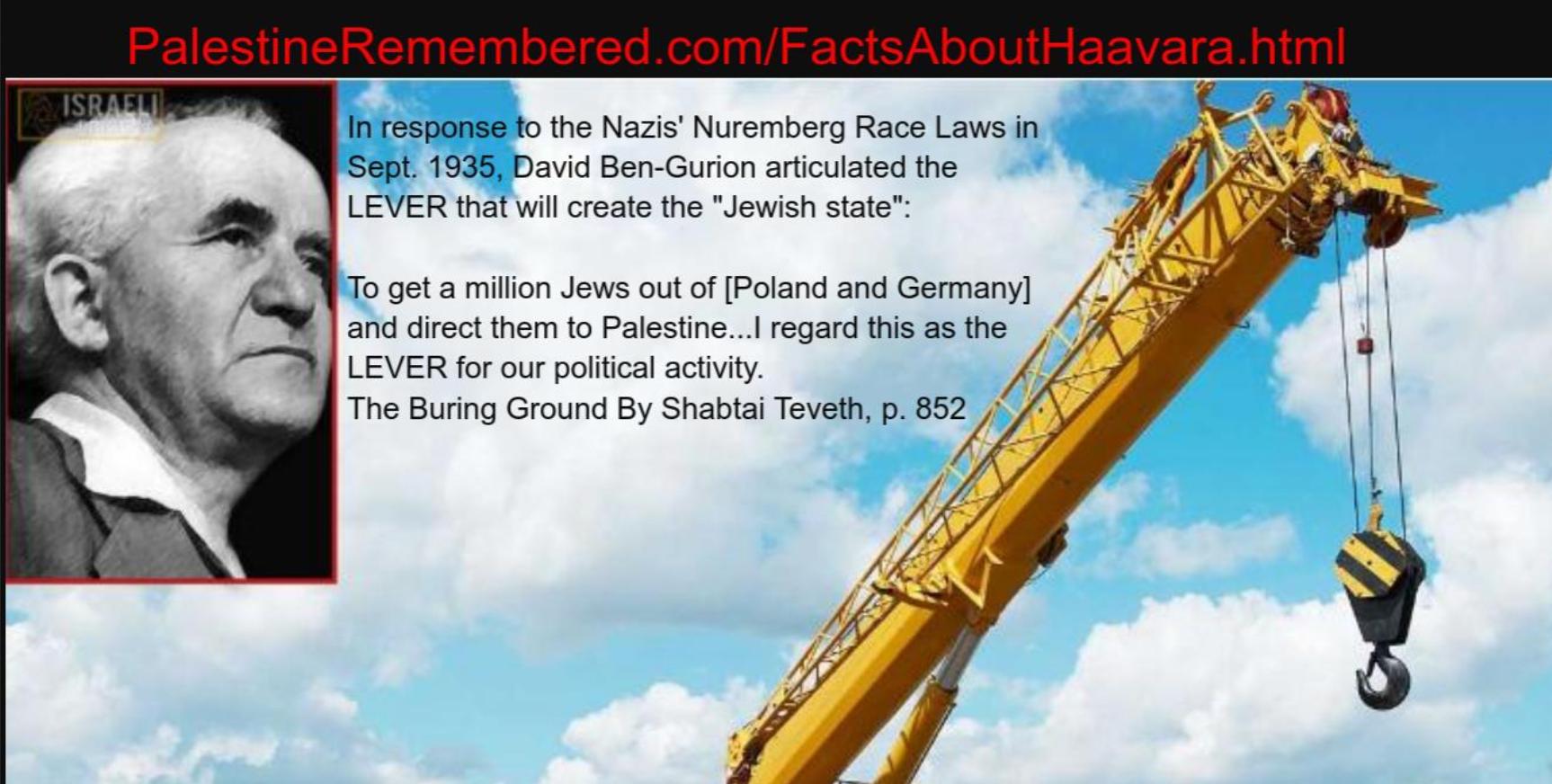 David Ben-Gurion envisioned that Nazis' Nuremberg Race Laws would become the LEVER that would end up creating the "Jewish state," but how? Click the image for the details
 There is no clearer illustration of this shift than Netanyahu’s address to his Finance Ministry, in which he conceded growing global isolation, arms embargoes, and international court proceedings. His solution was to urge his nation to pivot toward economic autarky and transform into a militarized "Super-Sparta."
To invoke Sparta is to invoke a warning, not a triumph. Ancient Sparta was an austere, garrisoned fortress state--culturally stagnant, economically dependent on a brutalized class of helots, and utterly incapable of adapting to a changing Mediterranean world. It was a society defined not by what it created, but by what it feared.
By framing his state's destiny as a "Super-Sparta," Netanyahu unwittingly exposed the fundamental bankruptcy of his project. He declared to his citizens and the world that diplomacy was dead, that soft power was irrelevant, and that the state had reached the limit of its capacity to persuade.
Yet, the immediate aftermath revealed the baseline friction of modern governance. Following his speech, the Tel Aviv Stock Exchange dropped, the shekel slid against the US dollar, and major business leadership groups issued blistering rebukes. Netanyahu held a hurried press conference the very next morning to "walk back" his comments, claiming his words were merely a misunderstanding regarding defense production.
This walk-back exposes a key paradox: while Netanyahu holds soft power and moral legitimacy in deep ideological contempt, the state remains tethered to global financial networks. However, capital acts merely as a short-term friction point. History demonstrates that hyper-nationalist and messianic regimes frequently choose economic stagnation over ideological retreat. The walk-back was not a change of heart, but a temporary tactical maneuver; as the garrison state deepens, leadership will inevitably attempt to crush, bypass, or accept market pain in pursuit of autarkic survival.
II. Genghis Khan Over Christ: The Contempt for Soft Power
 Palestinian Replacement In A Single Picture: al-Tira's school before and after Nakba. The same place but different people
This contempt for soft power is not a tactical maneuver; it is the core philosophical dogma of the modern garrison regime. Netanyahu made this explicit when citing historian Will Durant to press reporters:
"History proves that, unfortunately and unhappily, Jesus Christ has no advantage over Genghis Khan. Because if you are strong enough, ruthless enough, powerful enough, evil will overcome good."
In this single sentence, Netanyahu laid bare his worldview. Moral authority, ethical frameworks, international law, and soft persuasion--symbolized by Christ--are viewed not as legitimate dimensions of human power, but as foolish, naive weaknesses. Raw, unbridled physical coercion--symbolized by Genghis Khan--is enshrined as the only real currency in human history.
This logic fuels the doctrine of escalation dominance: the belief that if an adversary or a critical world community does not submit to force, the solution is never self-reflection, diplomacy, or structural reform. The only solution is more force. If the hammer failed to drive the nail, it simply means you did not swing the hammer hard enough. If you care, we have addressed the Sampson option in another article; it was almost applied during the Yom Kippur War of 1973.
III. Arendt and the Intellectual Bankruptcy of Force
In her 1969 treatise On Violence, Hannah Arendt drew a sharp, non-negotiable boundary that modern political commentators routinely miss: Power and violence are not synonymous; they are opposites.
"Power and violence are opposites; where the one rules absolutely, the other is absent. Violence appears where power is in jeopardy." -- Hannah Arendt
True Arendtian power emerges from legitimacy, consensus, alliances, and a shared political framework. It is the capacity of a society to act in concert voluntarily. Violence, by contrast, is the physical instrument brought in to substitute for power once legitimacy has collapsed.
When a state declares that its neighbors, its critics, or the international community "understand only force," it is not expressing strategic realism. It is confessing intellectual and moral bankruptcy. It is admitting that it possesses no ideas, no vision for co-existence, and no political architecture capable of generating peace.
Force is the final refuge of a leadership that has run completely out of arguments.
IV. The Hebrew Firewall and the Societal Consensus
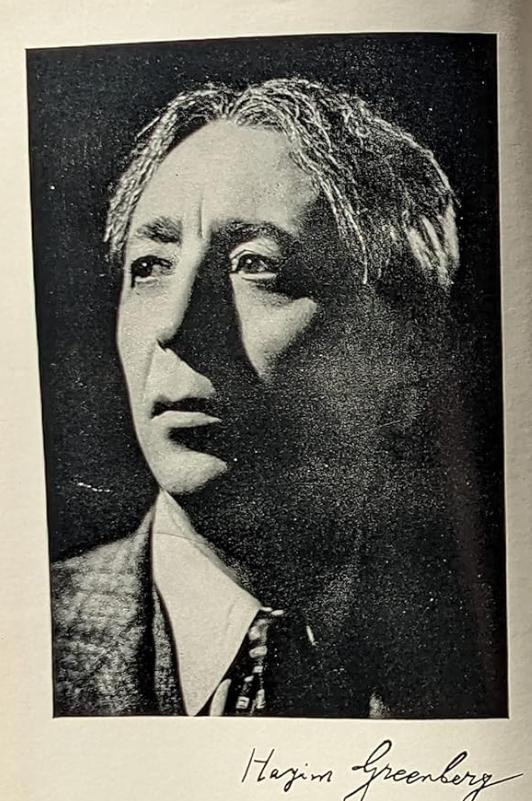 Why did Hayim Greenberg describe American Jewry as "morally bankrupt" in early 1943?
It would be a comforting mistake to view Netanyahu as an isolated demagogue imposing his will on an unwilling populace. In reality, he is the articulate mouthpiece of a deeply entrenched societal consensus.
When polls repeatedly demonstrate overwhelming domestic approval for maximum military operations--including overwhelming public enthusiasm for strikes on regional targets, genocide, and the relentless, daily destruction in Gaza--it reveals that the "hammer" logic has infected the entire body politic. The society itself has internalized the garrison mentality:
-
The Linguistic Island: Spoken natively by a small population, Hebrew functions internally as an information filter where military operations are framed exclusively as vital, moral, and existential self-defense.
-
Catastrophic Zionism: Grounded in the premise that antisemitism is an eternal, unalterable law of nature and that destruction is always imminent, this ideological framework views all external critique through the lens of existential threat.
-
Automated Delegitimization: Out of the gate, any internal or external critique is neutralized by immediate rhetorical weapons. If a critic is Jewish, they are instantly branded a "self-hating Jew." If the critic is non-Jewish, the charge of antisemitism is weaponized to shut down factual inquiry before it begins.
By treating all external feedback and humanitarian documentation as hostile noise to be blocked by its ideological and linguistic firewall, the society destroys its own steering wheel. It creates a closed cognitive loop, convinced that the only response to ongoing atrocities and global condemnation is more destruction.
V. The Second Law of Political Thermodynamics
This is where the physics of systems becomes terrifyingly applicable. The Second Law of Thermodynamics dictates that within an isolated or closed system, entropy (disorder) must always increase over time:
ΔStotal ≥ 0
If a state attempts to enforce absolute, artificial internal order (ΔStotal ≥ 0) through intense militarization, total narrative alignment, and rigid security apparatuses, it does not eliminate disorder. It merely exports the heat into its surrounding environment, while generating internal friction that degrades the container itself.
This is the "Refrigerator Effect." If you leave a refrigerator running with its door open inside a sealed room, the motor works overtime to cool the box. But because the heat coils on the back expel more heat energy than the front can absorb, the sealed room doesn't get colder--it burns.
A state operating as a closed entropic system consumes immense physical, financial, and moral energy to maintain its internal order. Because it refuses to exchange energy openly with its surroundings through diplomacy or structural reform, the system continuously overheats.
VI. Open Systems vs. The Garrison's Trap
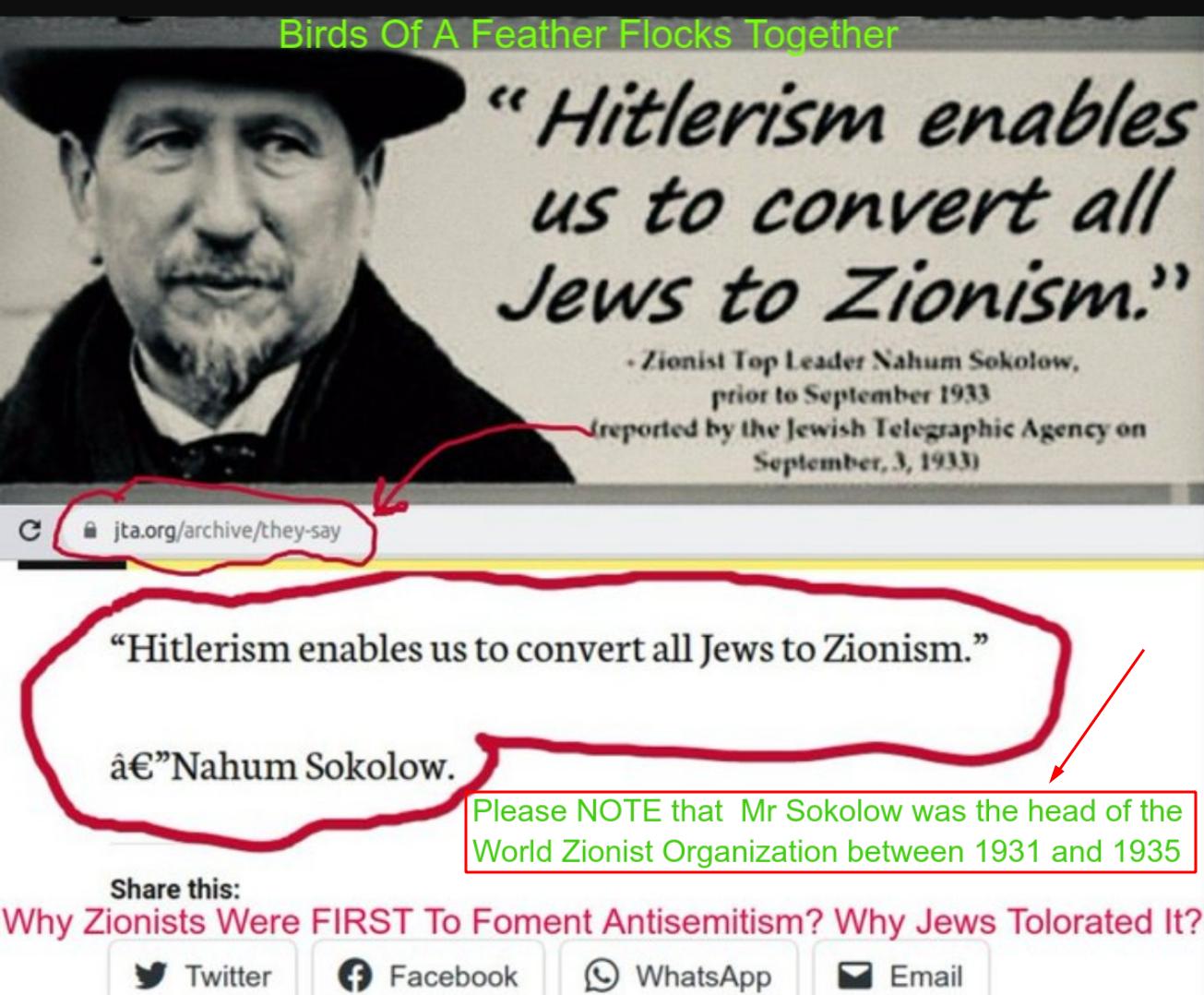 JTA Sept. 3rd, 1933 Quoting Nahum Sokolow: "Hitlerism enables us to convert all Jews to Zionism."
It is instructive to compare this trajectory with the political strains visible in Western democracies like the United States.
America is undeniably undergoing its own reactionary crisis. Institutional pressure--such as the targeted harassment and forced resignations of university presidents following October 7th Raid, or aggressive state attempts to limit unapproved discourse--demonstrates that open societies are not immune to authoritarian impulses. Algorithmic echo chambers, corporate media consolidation, and severe political polarization mean that heat and entropy are building at a dangerous rate within the American system.
However, America is not a closed linguistic island, nor is it governed by a singular, monolithic garrison ideology.
Because an open society remains embedded in a multilingual, globally interconnected environment, its feedback loops cannot be permanently silenced. Its citizens retain mechanisms--legal challenges, electoral shifts, independent journalism, and civil disobedience--to vent systemic heat and force structural adjustments without requiring total revolutionary collapse.
The danger for a small, closed garrison state is far more immediate. A modern nation cannot function indefinitely as an autarkic Sparta. The engines of modern prosperity require openness, international integration, and the rule of law.
When a leadership and a society see every problem as a nail, every critique as an existential threat, and every moral boundary as a weakness, they set off a self-fulfilling loop. The tragedy of the "Sparta model" is that it is fundamentally self-terminating. A state that relies exclusively on force, rejects external feedback, and isolates itself behind a firewall of its own making does not defeat its enemies through perpetual escalation.
It eventually generates so much heat, friction, and internal entropy that it brings down the entire house upon itself.


 Over 700 Oral History interviews (including 3,500+ hours of recording) can be viewed online.
Post Your Comment
*It should be NOTED that your email address won't be shared, and all communications between members will be routed via the website's mail server.