Zionist FAQs: The Aesthetics of Absolution: Khirbet Khizeh, Liberal Zionism, and the Mechanics of Performative Remorse
June 17, 1967: Israeli officer, to the left, directing Palestinians out of their village, 'Imwas.
The phenomenon of "Shooting and Crying" (Yorim Ve-Bochim) is one of the most perverse cultural mechanisms in modern statecraft. In Israeli political discourse, literary and cinematic self-flagellation is not a prelude to restitution, but a substitute for it. The state’s liberal establishment has long treated the mere recognition of its foundational crimes as a moral get-out-of-jail-free card.
By weaponizing remorse, liberal Zionism creates a framework where the perpetrator’s emotional anguish is elevated to the primary moral drama. At the same time, the material reality of the dispossessed--their erased villages, ongoing exile, and continuous military subjugation--is reduced to a static, secondary backdrop.
Remind Us Please: Who shall push whom into the sea? Jaffa Palestinians were being pushed into the sea in May 1948
This is the art of shedding crocodile tears (dma'ot tanin): shedding tears over the destruction of Palestinian society while actively retaining every dunam of land gained from that destruction, ensuring that the crime remains permanent even as its memory is aestheticized. Ultimately, liberal Zionists operate under the illusion that they deserve a moral free pass simply for acknowledging the destruction, even after overseeing a demographic catastrophe that violently reduced native Palestinians from roughly 90% of the legal citizen body to under 15% during the Nakba. Expecting moral absolution for engineering a demographic collapse of this magnitude--while continuing to execute those same structural crimes in the present--is cognitive dissonance on steroids.
Sadly, the liberal and progressive West has honored and celebrated this form of grotesque art for decades, elevating it into an established genre with a sick moniker: Shooting and Crying. This leaves Palestinians with a fundamental rhetorical question for liberal Zionists: Whom are you shooting at, and whom are you crying over? If, according to the founding national myth, Palestinians "did not exist," then who was being shot--and who is being wept over? The contradiction is as absurd as it is deadly. We prefer a slightly different version of this genre's name: shoot first and cry later.
1. The Author’s Paradox: S. Yizhar’s Curated Agony
Palestinians were ethnically cleansed out of al-Ramla & al-Lydd in July 1948 by Zionist Jewish forces, as you see, based on direct orders from Ben-Gurion, and executed by Yitzhak Rabin.
When S. Yizhar (Yizhar Smilansky) published his novella Khirbet Khizeh in 1949; it was celebrated as a masterpiece of moral courage. The book details the forced expulsion of a "fictionalized" Palestinian village during the Nakba war, capturing the unvarnished cruelty of the operation through the eyes of an agonizing Israeli soldier, and in 1964, the book became part of the Israeli high school curriculum! Soon we shall prove that there was nothing fictitious about the novella and the events were confirmed to be accurate by Yizhar's commander during the war of Nakba:
"We came, we shot, we burned, we blew up, we repulsed, we rejected, and we exiled... What the hell were we doing in this place?"
Yet, Yizhar’s subsequent career exposes the total decoupling of literary remorse from political action. Yizhar was not a marginalized dissident; he was Zionist royalty. Immediately after penning Khirbet Khizeh, he entered the Knesset as a lawmaker for David Ben-Gurion’s ruling Mapai party, serving continuously from 1949 to 1967.
┌───────────────────────────────────────────────────────────────────────────┐
│                       THE S. YIZHAR CONTRADICTION                         │
├───────────────────────────────────────────────────────────────────────────┤
│ IN LITERATURE (*Khirbet Khizeh*):                                         │
│ • Captures the horror of mass expulsion and civilian destruction.         │
│ • Wins the Israel Prize for Literature (1959)--the state's highest honor. │
├───────────────────────────────────────────────────────────────────────────┤
│ IN PARLIAMENT (Mapai / Rafi MK, 1949–1967):                               │
│ • Votes for the Absentees' Property Law, legalizing land confiscation.    │
│ • Supports Ben-Gurion's military rule over Palestinian citizens.          │
│ • Vehemently opposes the Palestinian Right of Return until his death      │
│   in 2006.                                                                │
└───────────────────────────────────────────────────────────────────────────┘
Palestinian Refugees on their way to Lebanon, Oct. 1948.
Yizhar’s life established the template for liberal Zionism: one can express profound, poetic guilt for the Nakba on the printed page, so long as one votes for the laws that ensure the expelled can never return to their homes. To his last breath, Yizhar maintained that 1948 was a necessary, existential war, viewing his book not as a call for historical justice, but as a therapeutic exercise designed to keep the soldier’s soul "pure" while executing the state's dirty work.
It is worth noting the ultimate dishonesty behind the novella's framing: in a 1978 essay, Yizhar persisted in claiming that Khirbet Khizehwas merely "a work of fiction". On the other hand, his former commander during the 1948 war, Yehuda Be'eri, publicly shattered that defense. Be'eri confirmed that the events depicted in the book were historically accurate eyewitness accounts, identifying them as the actual expulsion orders he issued for the Palestinian village of Khirbet al-Khisas and eight other nearby villages in the Gaza district on November 25, 1948. Yizhar's insistence on labeling the work "fiction" was a final literary maneuver to insulate himself and his society from the reality of the crime he helped commit.
2. The 1978 TV Adaptation and the Illusion of "Liberal Democracy"
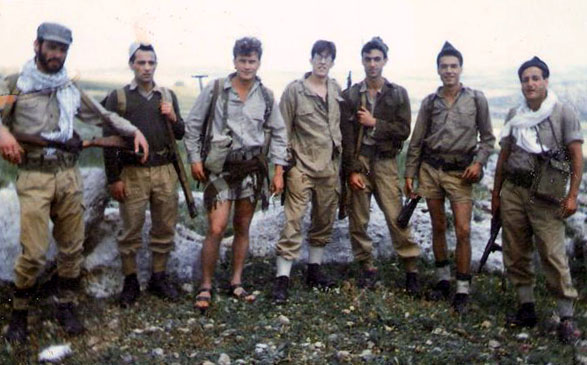
The case of the Israeli TV show: Khirbet Khizeh. Notice the one wearing the kuffiyyeh on the left!
In February 1978, director Ram Loevy adapted Khirbet Khizeh into a television film for the Israeli Broadcasting Authority (IBA). When Education Minister Aharon Yadlin and Likud officials attempted to censor the broadcast, arguing that it would serve as "enemy propaganda," the IBA television workers went on a historic strike. They cut the feed, leaving a black screen on national television until the government yielded and allowed the film to air.
For liberal Israeli Jews, this event was instantly converted into a triumphant national myth:
The Moral Inversion: Liberal commentary praised the strike as definitive proof of Israel's vibrant, open democracy. The state was lauded for having the "courage" to broadcast its own crimes on national television.
The Reality on the Ground: While liberal viewers beamed with pride over a black screen that symbolized free speech, the actual victims of the expulsions depicted in Khirbet Khizeh remained in refugee camps under military occupation in the West Bank and Gaza.
Faluja-Gaza, 1949, Ethnically Cleansed Palestinians on their way to Hebron
The broadcasting incident demonstrated how performative liberalism operates: the debate was subtly shifted from the material crime of ethnic cleansing to the domestic right of the perpetrator to watch a film about ethnic cleansing. The act of self-congratulation over airing the movie completely eclipsed the actual ongoing dispossession of the people on screen.
The broader irony lies in how state mythology evolved: while the immediate post-1948 generation recognized the physical expulsion in their literature and debates, later state narratives manufactured the lie that Palestinians "voluntarily abandoned" their homes. The existence of early works like Khirbet Khizeh is solid proof that everyone knew the truth, and that the "spontaneous flight" narrative was a post-hoc cover-up (we have uncovered similar myths that were concocted long after the Nakba). This creates a profound educational doublethink within Israeli society: in one high school classroom, students study Khirbet Khizeh in the official literature curriculum, reading about how their grandparents forcibly removed native villagers; in the very next classroom during a history lesson, they are taught the official propaganda that Palestinians fled voluntarily. This institutionalized doublethink is precisely how a state conditions a generation to execute and justify genocide while keeping its liberal conscience intact.
3. The Open Secret: Moshe Dayan and the Brutal Honesty of the Maximalist
What was written in Khirbet Khizeh was not a sudden revelation to Israeli society; it was an open secret. From Prime Minister David Ben-Gurion down to the regular foot soldier, everyone knew exactly how the native Palestinian population was replaced and dispossessed.
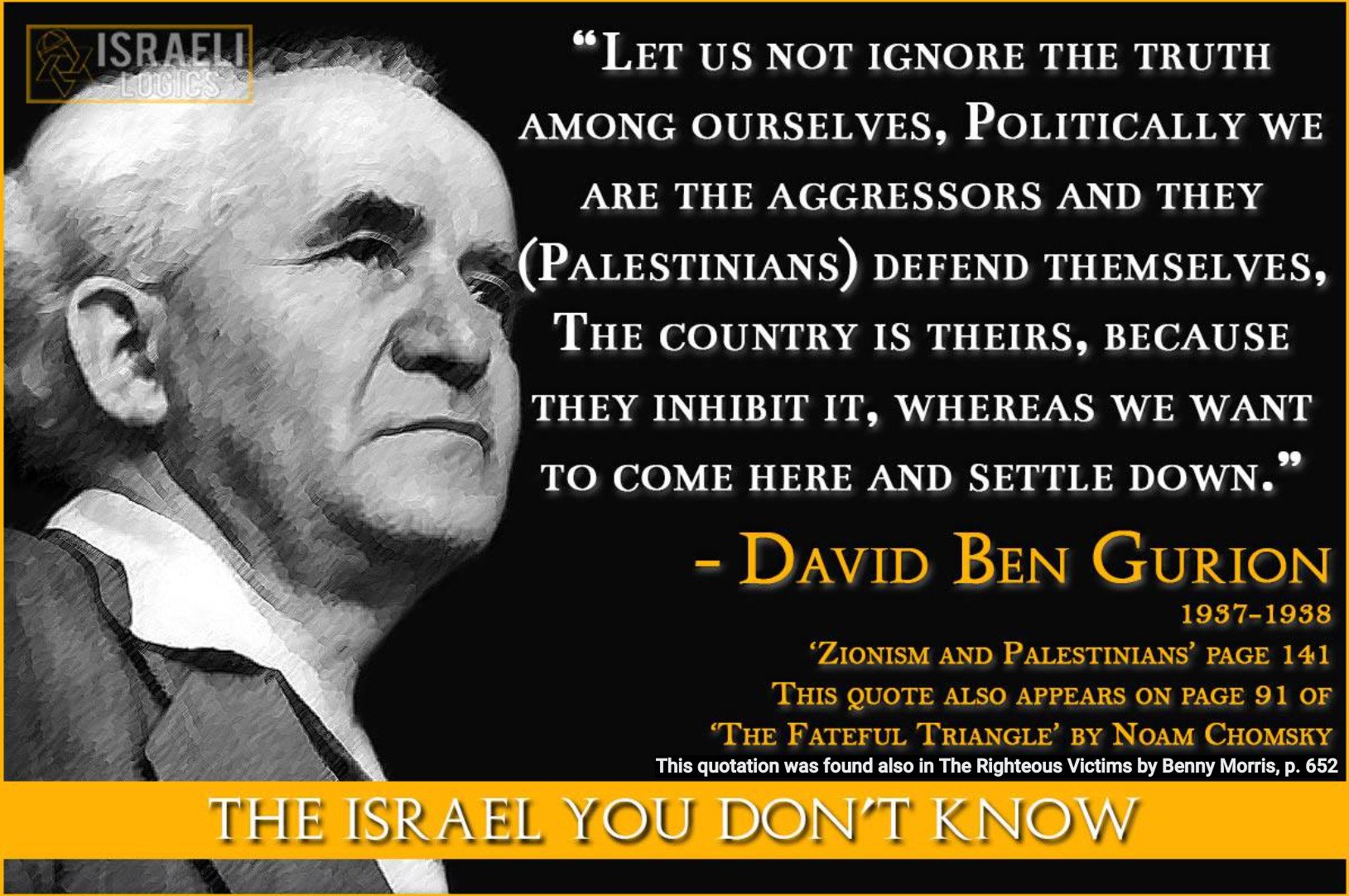
David Ben-Gurion: we're the aggressors; Arabs defend themselves. (Righteous Victims, p. 652)
To put things into perspective, one only needs to look at the words of Israel's most famous military commander, Moshe Dayan. In April 1956, just eight years after the Nakba, Dayan delivered a eulogy for an Israeli farmer, Roi Rotberg, who was killed by Palestinians near the Gaza border. Standing almost in the exact same location where military raids took place, Dayan did not resort to liberal gaslighting. He spoke with the unvarnished, brutal honesty of a conqueror:
"Let us not today fling accusation at the murderers. What cause have we to complain about their fierce hatred to us? For eight years now, they sit in their refugee camps in Gaza, and before their eyes we turn into our homestead the land and villages in which they and their forefathers have lived... We should demand his blood not from the [Palestinian] Arabs of Gaza but from ourselves... We are a generation of settlers, and without the steel helmet and gun barrel, we shall not be able to plant a tree or build a house." Cited in the Iron Wall by Avi Shlaim, p. 101 and and NYTimes by Roger Cohen on Nov. 30th, 2023.
Dayan stripped away the "Shooting and Crying" illusion. He explicitly acknowledged the theft of the land, the rightful grievance of the refugees trapped in Gaza, and the reality that the Zionist project was fundamentally a settler-colonial enterprise maintained exclusively by the "gun barrel."
This brings us to a tragic, bitter irony: Palestinians have historically received more accurate recognition of their reality--a twisted form of empathy, or at least validation of their existence--from the ruthless, unapologetic military architects of Zionism than they have from the so-called "liberal" press in the West. While liberal journalists and progressive academics twisted themselves into knots propagating the lie of "voluntary flight," commanders like Dayan bluntly admitted they were living on stolen Palestinian graves. One must ask: what is the goal of this liberal press? Propagating these lies only shields the perpetrators, erasing the victims while claiming to care about human rights.
4. Realpolitik in Practice: Yitzhak Rabin from Lydda to Latrun
NY Times Oct 22nd, 1979: Successive Israeli Governments censoring Yitzhak Rabin's admission that he ethnically cleansed Palestinians based on Ben-Gurion's orders.
The gap between performative remorse and realpolitik is nowhere clearer than in the military career of Yitzhak Rabin. In his 1979 memoir, Pinkas Sherut (Service Notebook), Rabin authored a candid account of Operation Dani in July 1948--the systematic expulsion of 50,000 to 70,000 Palestinian civilians from Lydda and al-Ramla; see NY Times Oct. 22nd, 1979, Soldier of Peace by Yitzhak Rabin, p. 140-1 & Benny Morris, p. 207.
When the Israeli military censorship committee excised these passages (which were subsequently leaked), they were suppressing a text that laid bare the internal psychology of the state:
Shifting Moral Culpability: Rabin threw Prime Minister David Ben-Gurion directly under the bus, recalling how Ben-Gurion dismissed the fate of the civilians with a single hand gesture and the command: "Garesh otam!" ("Drive them out!").
Centering the Soldier's Trauma: Rabin wrote at length about the "great suffering" inflicted not on the refugees walking through the summer heat, but on the young Palmach soldiers executing the eviction--soldiers raised on humanistic values who found the action "foreign" and distressing.
The State "Cure": Rabin detailed how the state administered ideological re-education (Mamlachtiyut) to numb the soldiers' liberal sensibilities, conditioning them to view the destruction of civilian lives as a heavy, necessary duty. It seems that Khirbet Khizeh is exactly what Rabin had in mind.
┌───────────────────────────────────────────────────────────────────────────┐
│                    THE 19-YEAR REPETITION CYCLE                           │
├───────────────────────────────────────────────────────────────────────────┤
│ 1948 -- LYDDA & AL-RAMLA:                                                    │
│ • Brigade Commander Rabin executes forced expulsions of ~60,000 civilians.│
│ • Laments the psychological toll on his humanistic Palmach troops.        │
├───────────────────────────────────────────────────────────────────────────┤
│ 1967 -- THE LATRUN VILLAGES:                                              │
│ • IDF Chief of Staff Rabin orders the total destruction of 'Imwas, Yalu,   │
│   and Beit Nuba.                                                          │
│ • Over 10,000 civilians are expelled; their ancient villages are razed    │
│   to the ground and converted into a recreational park ("Canada Park").   │
└───────────────────────────────────────────────────────────────────────────┘
Rabin's anguish in 1948 did not stop him from ordering the exact same destruction in 1967. The "crying" of 1948 served merely as an emotional intermission before the "shooting" of 1967.
In his seminal study States of Denial: Knowing About Atrocities and Suffering (2001), criminologist Stanley Cohen provided the analytical tool to deconstruct this behavior. Cohen categorized denial into three distinct layers, explaining how societies process uncomfortable truths:
                  ┌─────────────────────────────────────┐
                  │      1. LITERAL DENIAL              │
                  │   "It didn't happen."               │
                  │   (Official early 1948 myth:        │
                  │    "They fled voluntarily.")        │
                  └──────────────────┬──────────────────┘
                                     │
                                     ▼
                  ┌─────────────────────────────────────┐
                  │      2. INTERPRETIVE DENIAL         │
                  │   "It happened, but it's not what   │
                  │    you think; it was security."     │
                  └──────────────────┬──────────────────┘
                                     │
                                     ▼
                  ┌─────────────────────────────────────┐
                  │      3. IMPLICATIONAL DENIAL        │
                  │   "It happened, it was terrible,    │
                  │    WE FEEL BAD--but it changes      │
                  │    nothing today."                  │
                  └─────────────────────────────────────┘
Palestinian Refugees on their way to Lebanon, Oct. 1948.
Khirbet Khizeh and liberal Zionism represent the ultimate evolution of Implicational Denial. The facts of the crime are no longer contested (Literal Denial is abandoned). The brutality is even acknowledged as tragic (Interpretive Denial is partially set aside). Instead, the society settles into Implicational Denial:
Yes, we dispossessed you; yes, it was horrific; yes, we feel terrible about it--but there will be no Right of Return, no restitution of land, and no end to our demographic dominance. We shall do whatever it takes to persist the status quo plus more.
By operating within Implicational Denial, liberal Zionism creates a vacuum where moral recognition is completely severed from political consequences.
6. From Literature to Cinema: The Global Commodification of Perpetrator Trauma
In the 21st century, the "Shooting and Crying" ethos evolved from print and local television into a globally exported cinematic subgenre--one lavishly state-funded, celebrated at international film festivals, and rewarded by Western academies.
Western cultural institutions routinely reward this genre because it satisfies a specific ideological demand: it allows Western audiences to view military brutality through a humanistic, introspective lens, validating the myth that the state's soldiers are reluctant, tragic figures who suffer morally for the violence they inflict.
┌───────────────────────────────────────────────────────────────────────────┐
│               THE CINEMATIC COMMODIFICATION OF REMORSE                    │
├───────────────────────────────────────────────────────────────────────────┤
│ BEAFORT (2007) -- Dir. Joseph Cedar:                                       │
│ • Setting: Beaufort (Shuqief) Castle during the 18-year occupation of     │
│   Southern Lebanon.                                                       │
│ • Focus: The dread, claustrophobia, and existential angst of Israeli      │
│   soldiers stationed in the crusader fortress prior to the 2000 retreat.  │
│ • Omission: The thousands of Lebanese and Palestinian civilians bombed,   │
│   displaced, and killed during the occupation below the fortress.          │
│ • Acclaim: Silver Bear for Best Director (Berlin), Academy Award           │
│   nomination for Best Foreign Language Film.                              │
├───────────────────────────────────────────────────────────────────────────┤
│ WALTZ WITH BASHIR (2008) -- Dir. Ari Folman:                               │
│ • Setting: The 1982 Sabra and Shatila massacre in Beirut.                 │
│ • Focus: An ex-soldier's personal psychoanalytic journey to recover       │
│   repressed memories and deal with his personal PTSD/amnesia.             │
│ • Inversion: Converts a mass slaughter of refugees into a therapeutic    │
│   breakthrough for the soldier watching flares over the camp.             │
│ • Acclaim: Golden Globe winner, César Award winner, Academy Award         │
│   nomination for Best Foreign Language Film.                              │
└───────────────────────────────────────────────────────────────────────────┘
Palestinians were ethnically cleansed out of al-Ramla & al-Lydd in July 1948 by Zionist Jewish forces on direct orders from Ben-Gurion and executed by Yitzhak Rabin
In Joseph Cedar’s Beaufort, set at the ancient Crusader fortress of Shuqief Castle, the brutal 18-year occupation of Southern Lebanon is stripped of its victims. The film centers entirely on the psychological despair of young Israeli soldiers waiting to withdraw, turning the occupier into the tragic victim of an aimless war.
Ari Folman’s animated documentary Waltz with Bashirtook this dynamic to its zenith. The film purports to examine the 1982 Sabra and Shatila massacre, where Israeli forces surrounded the camps and facilitated the slaughter of thousands of Palestinian and Lebanese civilians. Yet the narrative arc of the film is not about the slaughtered families or structural accountability; it is about Ari Folman’s personal struggle with amnesia and guilt. The massacre is framed as a haunting nightmare that burdens the Israeli soldier's psyche.
The Israeli Foreign Ministry actively promoted Waltz with Bashir globally as diplomatic propaganda. As Israeli diplomats noted, the film served as a masterclass in brand management: it proved that Israel possessed "moral introspection" and could produce "humanistic art," transforming an atrocity into proof of moral superiority.
Who shall push who into the sea? Haifa's Palestinians are being loaded onto ships out of their homes, April 1948
This institutionalized artistic machinery reveals the blueprint for how the genocide in Gaza will be processed in the future. Years from now, once the physical obliteration, mass starvation, and land clearing of Gaza are completed, the same cultural apparatus will swing into gear:
The Introspective Masterpiece: Israeli filmmakers will receive state grants and international co-productions to create poignant, avant-garde films or animated dramas exploring the "moral injury," "PTSD," and heavy, soul-crushing burdens carried by IDF drone operators, artillery gunners, and pilots.
Western Acclaim: Western film festivals at Cannes, Venice, and Los Angeles will shower these productions with nominations and awards, praising the "courageous self-criticism" and "profound humanity" of the Israeli artistic establishment.
The Silent Victims: The tens of thousands of murdered Palestinian children, the flattened cities, and the permanently displaced survivors will remain voiceless, cinematic props--necessary background scenery for the perpetrator’s dramatic journey toward self-discovery and emotional healing.
7. Demolishing the "Free Pass": Why Performative Liberalism Is Worse
Palestinians were ethnically cleansed out of al-Ramla & al-Lydd in July 1948 by Zionist Jewish forces on direct orders from Ben-Gurion, and executed by Yitzhak Rabin
When liberal Zionists ask for a "free pass" because they openly discuss the Nakba or criticize current state policies, they demand gratitude for performative empathy. They expect the victim to validate their sensitive conscience while they continue to enjoy the material dividends of the crime.
This is why many dispossessed people express far more respect for the stark clarity of hardline maximalists like Menachem Begin, Ariel Sharon, or Itamar Ben-Gvir. The maximalist Right does not gaslight its victims. They offer power without pretense: "We took the land because we wanted it, might makes right, and we feel no remorse."
The liberal Zionist, by contrast, demands to execute the dispossession, enjoy the land, write a masterpiece about their guilt, receive an international award for open-mindedness, and then lecture the victim on human rights.
Recognizing a crime while continuing to profit from it is not liberalism--it is the aestheticization of tyranny. Sympathy without restitution is merely the polite face of ongoing erasure.
 Menu
Menu June 17, 1967: Israeli officer, to the left, directing Palestinians out of their village, 'Imwas.
 Remind Us Please: Who shall push whom into the sea? Jaffa Palestinians were being pushed into the sea in May 1948
 Palestinians were ethnically cleansed out of al-Ramla & al-Lydd in July 1948 by Zionist Jewish forces, as you see, based on direct orders from Ben-Gurion, and executed by Yitzhak Rabin.
 Palestinian Refugees on their way to Lebanon, Oct. 1948.
  The case of the Israeli TV show: Khirbet Khizeh. Notice the one wearing the kuffiyyeh on the left!
 David Ben-Gurion: we're the aggressors; Arabs defend themselves. (Righteous Victims, p. 652)
  NY Times Oct 22nd, 1979: Successive Israeli Governments censoring Yitzhak Rabin's admission that he ethnically cleansed Palestinians based on Ben-Gurion's orders.
 Palestinians were ethnically cleansed out of al-Ramla & al-Lydd in July 1948 by Zionist Jewish forces on direct orders from Ben-Gurion and executed by Yitzhak Rabin
 Palestinians were ethnically cleansed out of al-Ramla & al-Lydd in July 1948 by Zionist Jewish forces on direct orders from Ben-Gurion, and executed by Yitzhak Rabin


 Over 700 Oral History interviews (including 3,500+ hours of recording) can be viewed online.
Post Your Comment
*It should be NOTED that your email address won't be shared, and all communications between members will be routed via the website's mail server.