 Menu
MenuWhat was the size of the Haavara Agreement?
How critical was it for the creation of the "Jewish state"?
Introduction
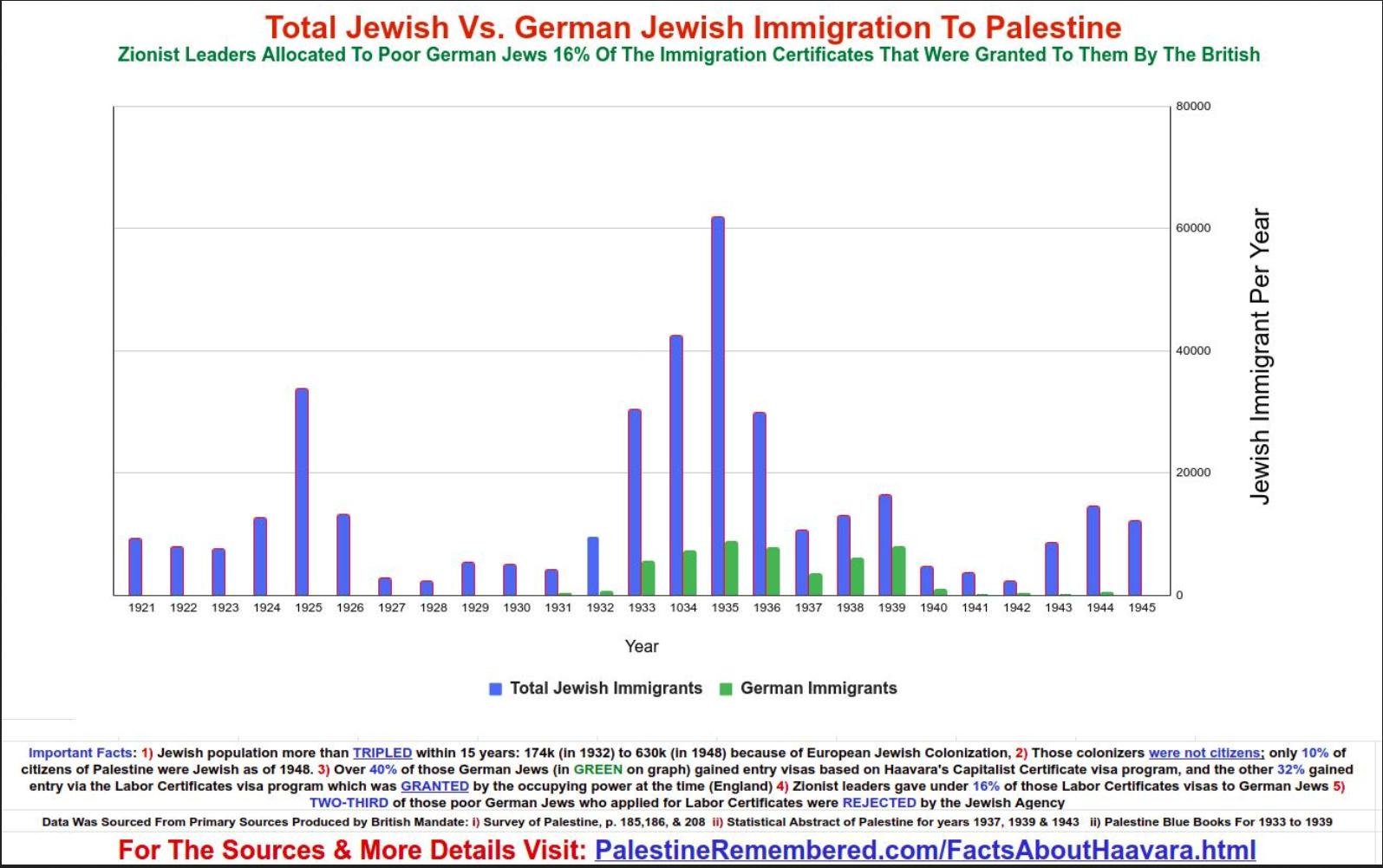 Let's Do The Math: How Many German Jews Were Actually "Saved" Due To The Haavara Agreement?
Most historians who researched the Haavara Agreement reported a total sum of RM140 million Reichsmarks (or P£8.1 million) was transacted in 8-9 years of operation. Keep in mind that between 1933 and 1939, on average, every P£ was worth RM17.28, and each P£ was worth $5. As we shall prove soon below, we strongly suspect the official of figure of P£8.1 million was only a fraction of the actual figure.
Red Flags: The Discrepancies
Here are the most significant discrepancies we have found compared with the official numbers:
1) Although Edwin Black reported RM105 million instead of the official number of RM140 million, he alluded on page 379 that there was another $70 million (about RM210 million) that "flowed into Palestine via corollary German commercial agreements and special international banking transactions", see The Transfer Agreement, p. 379. Honestly, we looked hard, and we have no idea what that means and how he arrived at these figures! Notice how Mr. Black never cited his sources, although he is well-known for meticulously citing his sources. It should be noted that Mr. Black's work is often cited, especially concerning the total number of German Jewish immigrants of 60,0000, which we found to be inflated by almost 30%.
In any case, if we assume that Edwin's numbers were accurate, then that implies that the total is over double (RM315 million = P£18.2 million) the official amount of P£8.1 million. This discrepancy was the first major red flag.
 JA's memorandum at Evian Table showing the influx of capital into the Anglo-Palestine Bank between 1932 and 1937
2) When we examined the Jewish Agency's primary sources for 1933, 3,473 Capitalists (dependants were omitted) immigrated to Palestine in 1933. Half of those came from Germany, and on average, they brought more than double the minimum required amount of P£1,000. Thus, in total, they brought with them no less than P£3 million, see Jewish Agency's Submission to the League of Nations, p. 6. This 1933 figure alone, which represented only 15% (1,500 Capitalist immigrants) of the total German Capitalist immigrants, accounted for close to 37% of the official figure of P£8.1 million. This was a major red flag.
3) As we were reviewing the Jewish Agency's memorandum (submitted at the Evian Conference in July of 1938), the Jewish Agency cited that P£38 million (or $190M) were deposited into the Anglo-Palestine Bank's private accounts within five years (1933-37). Since we know that most Eastern European Jewish immigrants were penniless (and relied on Zionist institutions for support), we can safely conclude that much of those funds were transacted via Haavara based on German Jews' transferred assets. This is already more than twice the upper bound reported by Mr. Black earlier. Note that these P£38 million: i) were deposited into a single bank; there could have been multiple banks, too! ii) This number pertains only to years between 1933-37 (all inclusive), but we don't know how much was transacted between 1938-41. iii) Most importantly, this doesn't account for institutional money transfer. Meaning, the P£38 million (or $190M) pertains to private funds only! It is as if the official number we know is only the tip of the iceberg!
4) As of March 1938, RM83 million had been transferred, see Halamish, p. 136. This implies that RM57 million had been transferred within 18 to 19 months! It is fishy that 40% (57/140) of the total fund was transacted in a very short time window!
 Haavara funneled into Zionists' enterprises drained coffers more than the total amount of the Molotov-Ribbentrop Pact of 1939
5) We were stunned to read in Avraham Barkai's From Boycott To Annihilation on page 103, where he cited a Central Zionist Archives document (CZA p. 25/9810) that reported RM250 million, as of early 1936, was in blocked accounts (I & II) waiting to be cleared, and in August of 1938, that was RM84 million! By any measure, those are massive figures which confirm our interpretation! Of course, we are aware of the taxes and subsidies that had to be paid to clear the transactions out of Germany, but still, these two numbers alone give us a snapshot of what has been cleared already two years after Haavara was signed, and those figures dwarf the official numbers. Those figures were major red flags.
6) Jan C. Horak (p. 52 & 57) cited that six million pounds sterling was transferred as of December 1935. Since the Palestinian Pound (P£) was at par with the sterling, that implies that 75% of the official figure (P£8.1 Million) was transferred within the first two years of the agreement. This sounds very fishy since that implies P£2.1 million was cleared in the next three years. As we shall see, much more was transacted in the following three-plus years. This was a major red flag.
7) Abraham Edelheit reported that P£500,000 were transferred with no flight tax via a similar Haavara agreement with Latvia; a similar number was reported for Czech, too, see The Yishuv In The Shadow Of The Holocaust, p. 110. These numbers are huge to come from several small countries within two years of operation. In total, both countries transferred 1/8th of what we officially know as Haavara, which cumulatively transferred out of Germany within seven years (P£8.1 Million)! These transfers raise similar red flags that Haavara's total number is suspect, as if what we know is only a fraction of the total size! Other implementations of Haavara are still in an information black hole; we hope others will shed more light on them.
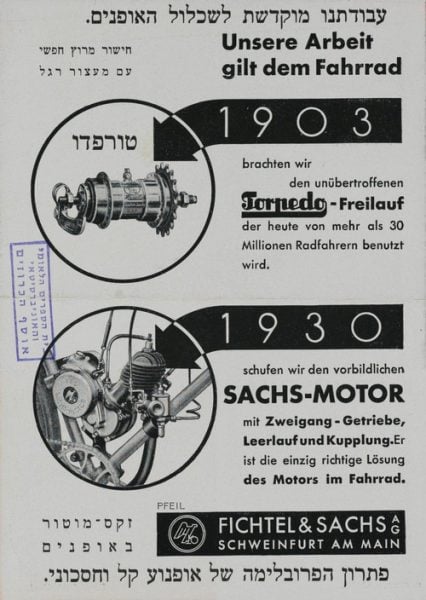 Zionists marketed Nazi goods in Palestine in the 1930s
8) Areih Tartakower & Kurt Grossmann reported on pages 386-387 that those who immigrated via the Capitalists visa program brought P£6,750 million between 1937-41. We must assume this was an error; the number should have been P£6.75 million (one-hundredth of what was reported). Assuming this figure is acceptable, that means P£1.35 million was transacted between 1933 & 36, and this is a big discrepancy. Please pay attention to how the authors reported a figure of P£30 million on p. 387, but they didn't report how it entered Palestine without going through Haavara. These discrepancies were another major red flag.
9) Since the German Jews who immigrated using their transferred assets were close to 10,000 (dependants were excluded, here are our detailed calculations, see also Tom Segev, p. 22, Edwin Black p. 379, Jews For Sale?, p. 17 & 35, Statistical Abstract of Palestine for 1937 on p. 36 and 1943 on p. 17 plus Avraham Barkai), then that implies a total of at least P£10 million were transferred (since each immigrant was required to bring at least P£1,000), and that is 125% larger than the original figure of P£8.1! Remember that the German Jewish immigrant was left with as little cash as possible upon his or her arrival in Palestine, see Edwin Black, p. 379. Often, those Capitalist immigrants transferred much larger amounts than the minimum required by the British Mandate, and we haven't yet factored in institutional transfers plus Sonderkonto II accounts. Those discrepancies were another major red flag.
10) Pension transfers were another part of Haavara that we know very little about. Pension transfers were prioritized over other types; see this December 9th, 1934 JTA article for the details.
Conclusion
All these significant discrepancies led us to conclude that the official number is only a fraction of the actual figure. At a minimum, what Mr. Black reported (RM315 million = P£18.2 million, about $105 million) is the least we should accept until more exhaustive research is done.
Therefore, the official number reported (RM140 million) must be called into question.
Putting Haavara's Total Size In Perspective
Anyhow, let's now put things into perspective to give you an idea of how massive Haavara was:
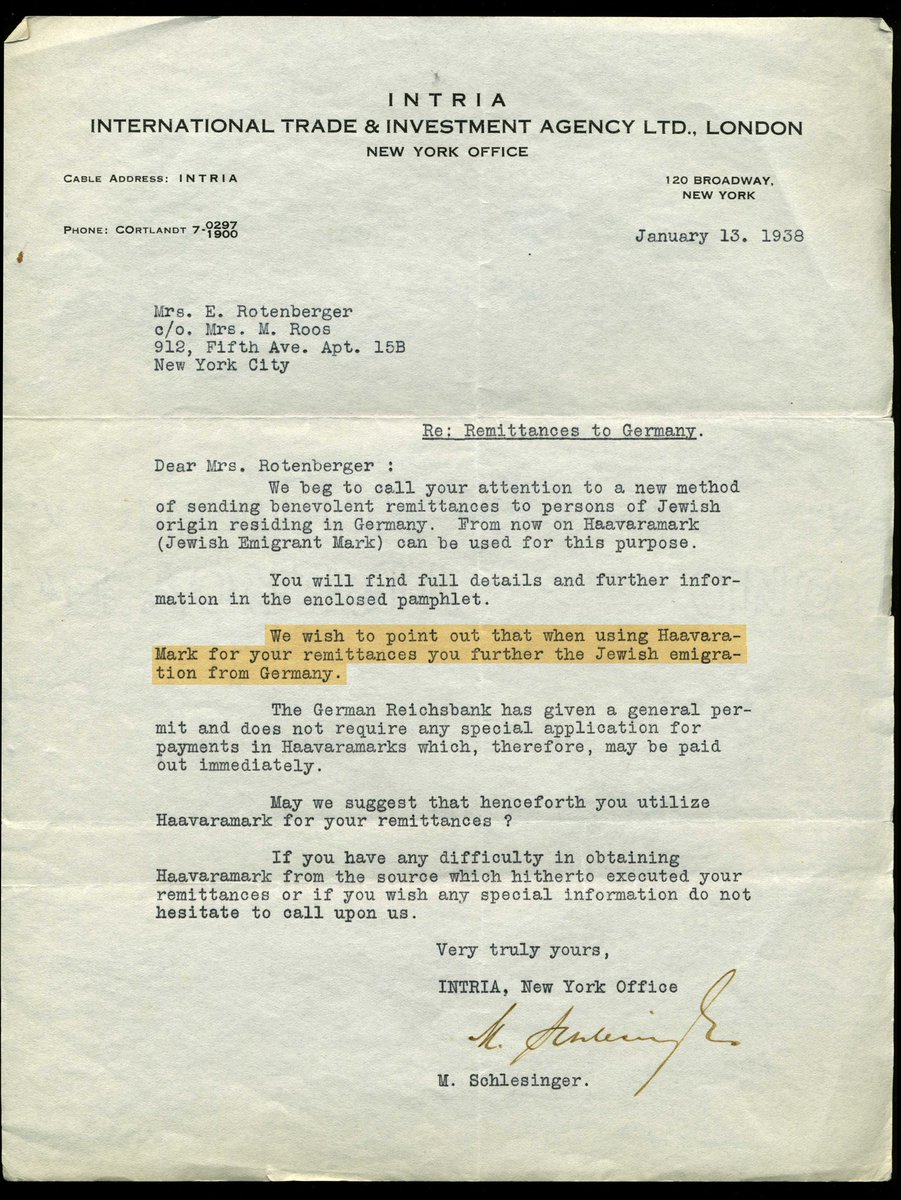 INTRIA: Haavara-Mark wire transfer (more like PayPal nowadays) from NYC to Germany, 1938
 $105 million (RM315 million) was 35 times the 1929 or 1933 Jewish Agency's budget of $3 million!
Haavara funneled into the Jewish Agency's drained coffers in 7-8 years as much as 150% of the German-Soviet treaty (Molotov-Ribbentrop Pact) of 1939 (RM 200 million), and 75% of the expanded 1940 (RM 420 million) version!
As you consider the earlier statistics, keep in mind that 3/4th of the Jewish Agency's budget was in deficit between 1930 and 33. Therefore, it is safe to conclude that Hitler, the father of antisemitism, was the one who bailed out the so-called yishuv at a moment of crisis.
Spoiler Alert: The same thing was replicated by Hitler's children 5 years after the Holocaust ended in the early 1950s. Then, the "Jewish state" faced a similar existential financial crisis and could not feed its population two years after Nakba!
Let's compare Haavara's total income to the Government of Palestine's budget, revenues, and expenditures between 1922 and 1945. Pay attention to Palestine's statistics between 1930 and 1940; you'll see how Haavara's transfers were comparable to the Palestine Government's revenues and expenditures in the 1930s. Again, remember that at the time, every P£ was worth about 5 US dollars, and the Palestinian Pound (P£) was at parity with the British Pound (the Sterling).
It should be emphasized that this massive amount was injected into an economy A) that had a much lower standard of living compared with Germany, B) suffered from deflation (note how Palestine's price index was down by 40% by the mid-1930s), and C) most importantly this amount was used to finance a minor non-state actor (the Jews in Palestine were under 174,000 as of 1931-2) that was on the verge of going bankrupt during the Great Depression!
The Influx Of Funds After Haavara Was Signed
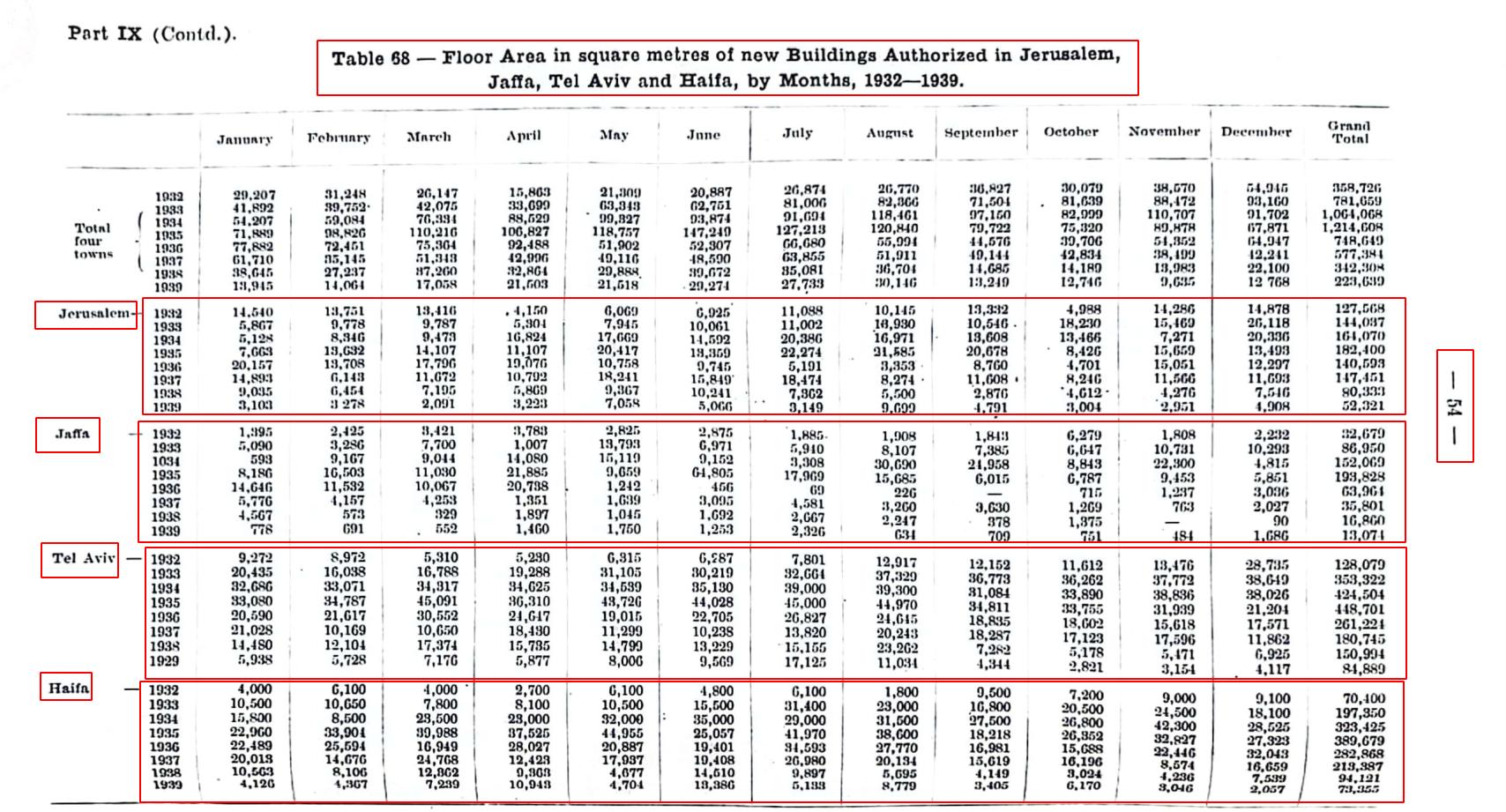 Detailed reports of building activities in the major cities in Palestine during the 1930s, broken up by city, month, year, and community. Note the remarkable jump during Haavara's seven years of life compared to before
To give the reader another idea about the influx of funds and equipment that entered Palestine because of Haavara, here's a table from Survey of Palestine showing how industrial equipment & investment jumped by 400% between 1933-39, much of which was because Haavara! It should be noted that Haavara funds were used to finance building over 60% of the Jewish colonies in Palestine in the 1930s and early 1940s, see The Transfer Agreement, p. 379.
Keep in mind that before Haavara, the Leumi Bank (formerly Anglo-Palestine Bank) was very small. However, after it got exclusive rights to handle Haavara transactions, it was transformed overnight into one of the top hundred banks worldwide, see The Transfer Agreement, p. 226. Note also that this Bank's British license operated with fractional reserve banking systems that allow credit creation multiple times of total deposits, which was re-invested into Zionists' communal enterprises (JNF, Histadrut, Kupat Holim, Mekoroth, Lodzia, Haganah, Rassco, Tnuva, ...etc.) when this scheme is coupled with locking the capital within Zionist enterprises, plus restricting cash withdrawals and restricting shared stock redemption (in Zionist enterprises), that resulted in an ingenious financial system that is resilient and self-reinforcing, which leaks out as little capital as possible.
For greater detail on how this instrument was set up, we urge you to pay attention to chapter 27 in The Transfer Agreement (p. 253 - 260), especially how the German Jews' blocked accounts were used as collateral to issue and trade "development bonds" at a trading house that later evolved to become the Tel-Aviv Stock Exchange!
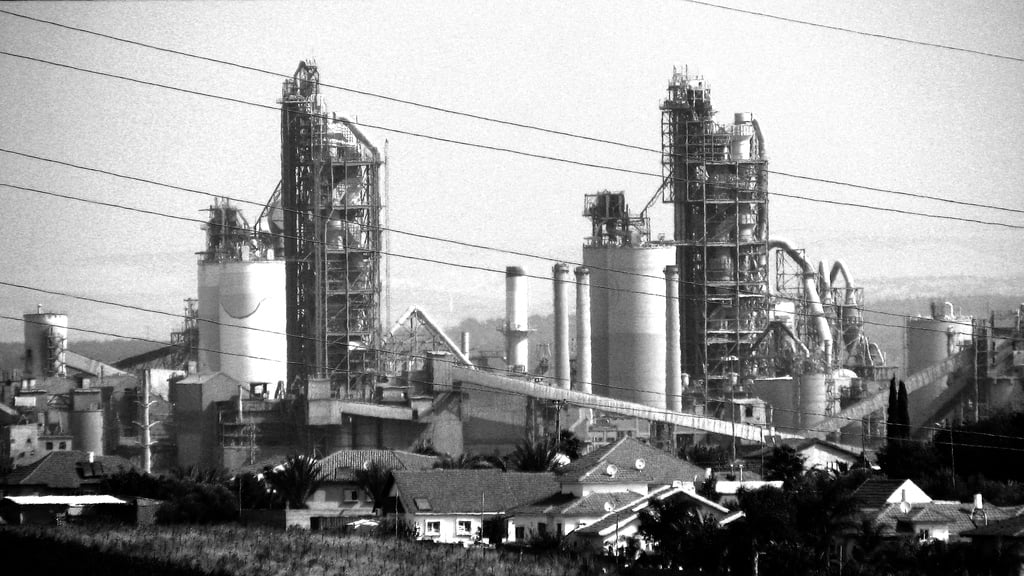 Nesher cement factory, Haifa, may have been a recipient of Haavara-related funds since it had a monopoly on cement
As soon as Haavara was signed in 1933, Zionists immediately started to import from Nazi Germany: cement factories, steelworks, breweries, bakeries, printing presses & medical facilities, plus the technical know-how to operate them. (The Transfer Agreement, p. 353) According to this research and this Ha'aetz article, over 4,000 buildings in the White City (Tel Aviv) were built from materials imported from Nazi Germany! We suspect something similar happened in Haifa since it was and still is a "Yekkes" city, and we suspect it happened in Jaffa, too. Just in case you're interested in boring details, here are detailed reports about the building activities in Palestine between 1931 and 1939; note the remarkable jump in construction during Haavara's seven years of life compared to before
-Is it possible that Haavara may have also included receiving Nazi weapons & military training? It should be noted that the Nazis allowed Zionists to set up tens of vocational training camps, which persisted until the early 1940s!
-Is it possible that Haavara may have also included intelligence gathering on anti-fascist & pro-boycott Jews (i.e., BUND), USSR, Poland, oil resources in the Middle East & North Africa, & Great Britain? (Zionism and Anti-Antisemitism in Nazi Germany, p. 123-126)
Why are those far-fetched ideas? Already, Zionists were dealing with & enabling the devil. Therefore, why not go all the way for an advantage? After all, they could Hasbarah (gaslight) their actions with: we had to do all we could to "save" lives!
What Is Still Hidden About The Haavara Agreement?
It should be noted that much of Haavara's transactions are still hidden; we are told much of the data is locked, and most are in Hebrew and German. Therefore, we suspect that we have barely scratched the surface. For example,
How many institutional transfers were handled via Haavara?
Which Zionist communal enterprise benefited and how?
The same goes for the money transfer functionality in Haavara; how many of the overall transactions went through Haavara?
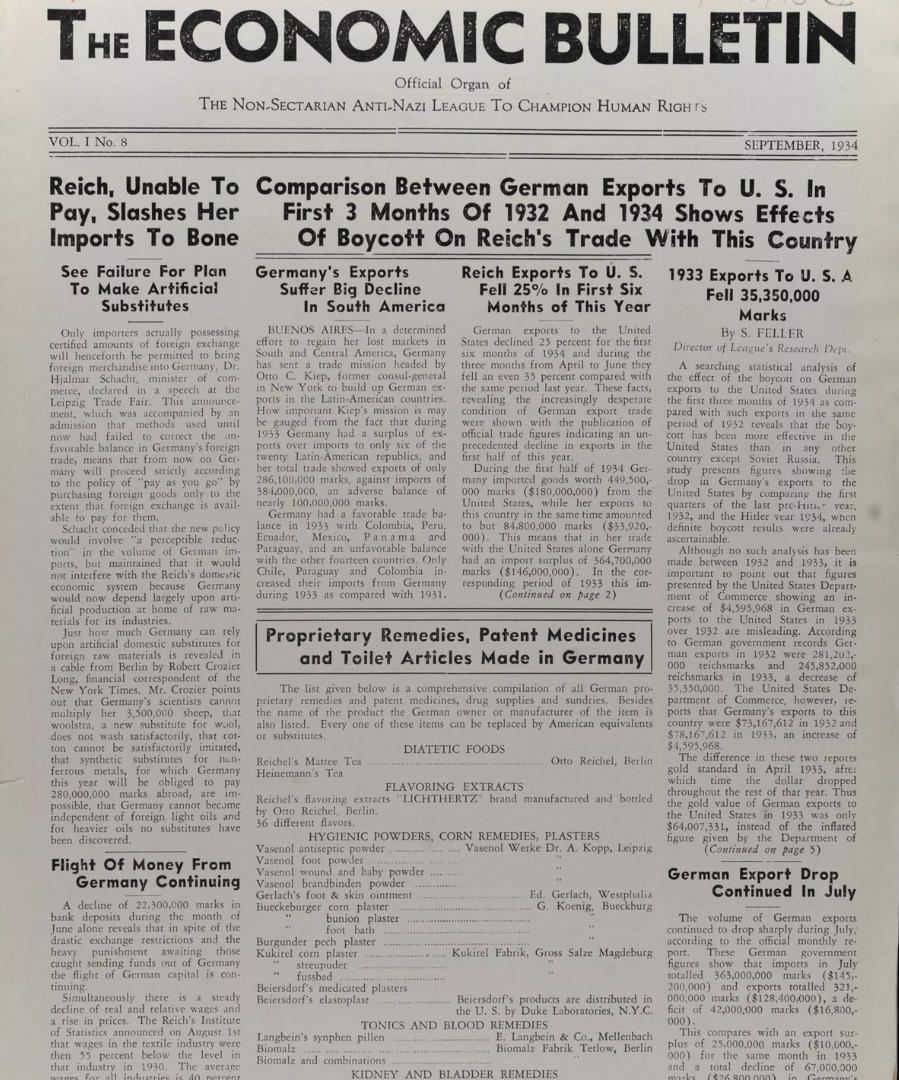 The Economic Bulletin Of The Anti-Nazi-League, Sept. 1934 Report
 How were Haavara funds traded as securities? What was the size of the trades? Who cleared the trades and where (i.e., were London & N.Y. City included)? Their records should be examined.
Was Haavara ever used to sell Nazi goods WITHOUT using German Jews' money as collateral (i.e., in blocked accounts)? Was Haavara allowed to operate as a free agent dealer to promote Germany's economy, irrespective of the collateral or financing?
How did the massive revolving line of credit worth P£2.5M (which was extended by the Reichsbank) function?
What was the size of Haavara-related trades in the Middle East and North Africa?
Did Zionists sell Nazi goods in Eastern/Central Europe, Asia, and the Americas besides MENA? Ports' logs should be examined if available.
How much, on average, did Haavara pay to subsidize German exports (i.e., make German exports competitive)? Where were they traded?
Did Nazis ever use Haavara's money transfer utility as a payment system around the world to settle trades?
Since the German Jews who immigrated to Palestine as Capitalists made up 40% of all Capitalists, it would be interesting to find out how the Jewish Agency taxed the other 60%.
What was the size of pensioners' transfers?
How did German Jews, who visited Palestine as travelers, use Haavara to pay for their expenses?
How were Haavara-Marks being traded and under what rules inside and outside of Germany? See this relevant JTA report on Dec. 19th, 1937.
What was imported via Haavara, and to whom?
How many Arabs have used it? Who? Which banks cleared the trades? Banks' logs should be examined and cross-checked with what Haavara's management disclosed.
Did Haavara ever pay taxes on its transactions? Or did the British exempt Haavara from paying taxes?
Before the US entered WWII in late 1941, was Haavara ever used to pay anti-war activists, Christian evangelical clergies, Nazi spies, or US politicians in the US on behalf of Hitler?
Was Haavara money ever used to finance lobbying activities in the US? Did the US Government know of these lobbying activities on behalf of a foreign non-state agent, especially during WWII?
Breakdown of what was imported by sectors?
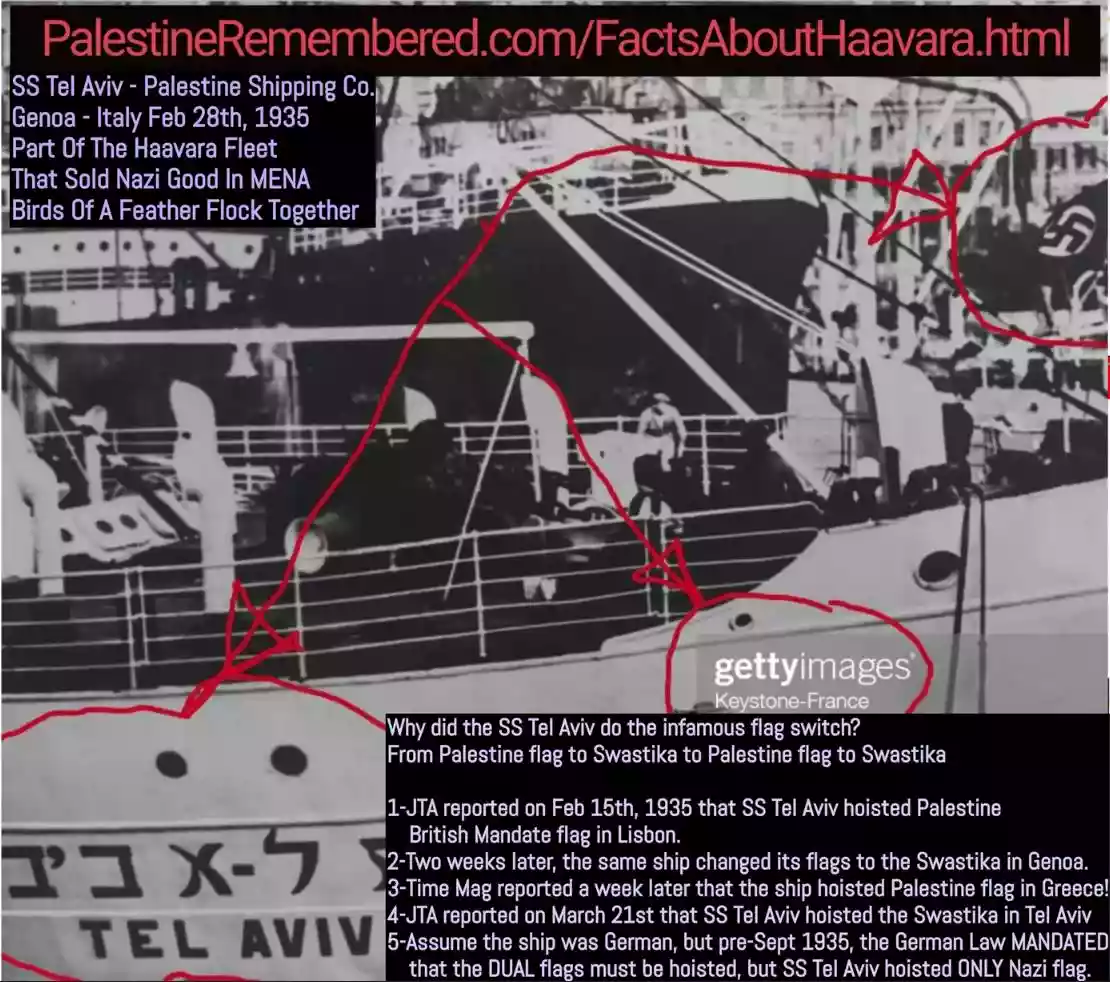
To what extent did Zionists' owned ships play a role in delivering Nazi goods to markets & to where? What was the size of the Zionists' fleet? As of 1935, we know of ten. How many of those ships hoisted the Swastika as the SS Tel Aviv and the Atid steamers?
After the Nazi occupation of Poland in Oct. 1939, it was used until the Americans shut it down in December 1941.
Did the British Mandate regulate Haavara? What trades were executed during WWII?
Was Haavara ever used to pay ransom money during the war? Was Haavara ever used to pay ransom money during the war? Did the Zionist leadership ever refuse to use Haavara for paying ransom?
As of March 1938, RM83 million had been transferred (Halamish, p. 136). This implies that RM57 million had been transferred within 18 months. What accounted for that?
Finally, it will be nice to have access to the Jewish Agency & other Jewish Groups' annual budgets, income, and expenditures per year between 1920 48. The same goes for Zionist enterprises, including JNF and Histadrut.


 Over 700 Oral History interviews (including 3,500+ hours of recording) can be viewed online.
Post Your Comment
*It should be NOTED that your email address won't be shared, and all communications between members will be routed via the website's mail server.